
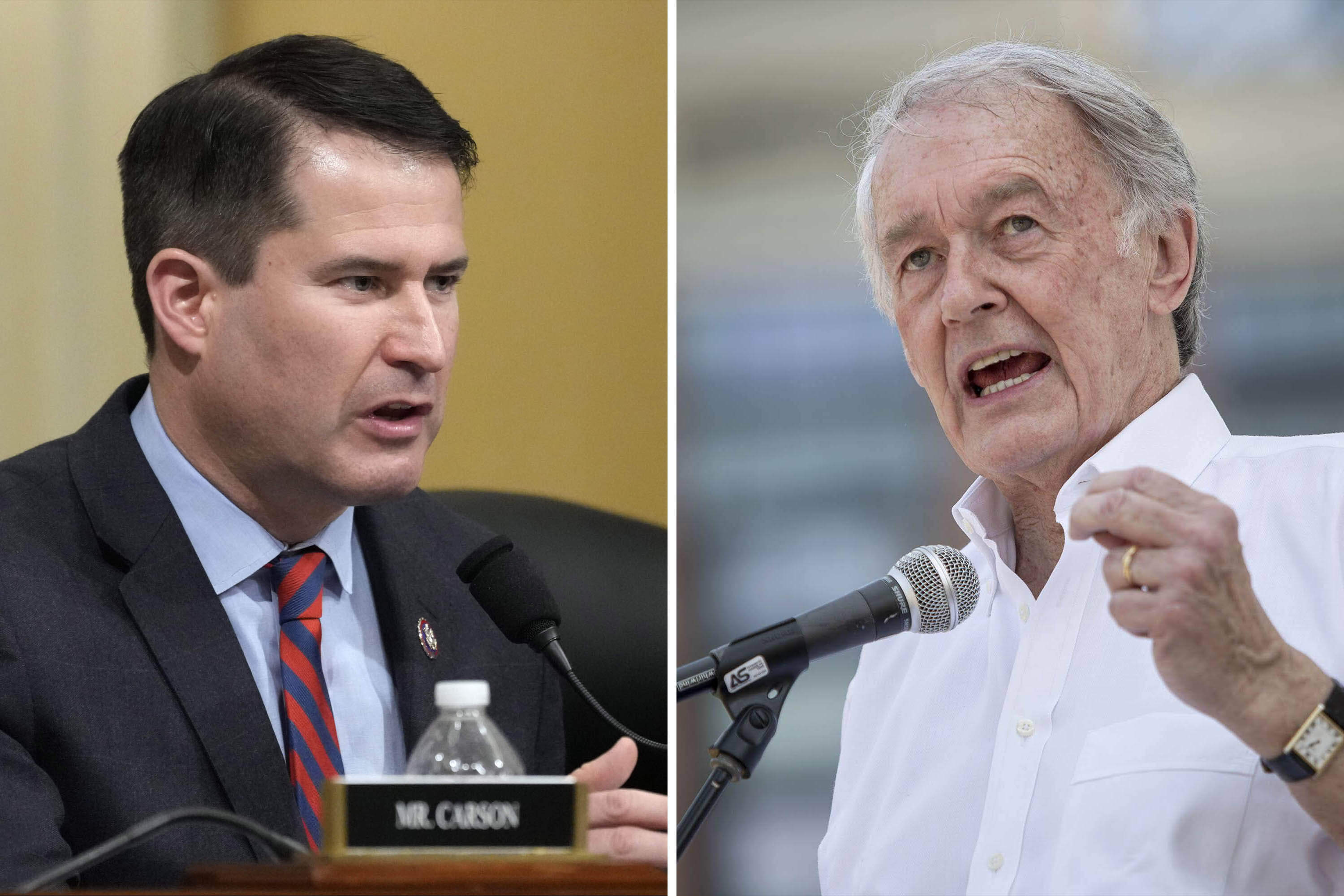
Bay State Democrats have arranged themselves in a circular firing squad, leaving voters to choose between a senator who is old (80) but effective, or a congressman who is younger (47)– and gratuitously snide. Monday night’s televised debate between incumbent Senator Ed Markey and 6th District Congressman Seth Moulton was a contentious, unpleasant exchange that revealed few ideological or substantive differences and raised a fundamental question about what, exactly, a generational change in this race might mean for Massachusetts.
The question beneath the debate was whether Moulton had a coherent case for replacing Markey. On policy, the two agree on most issues; where they differ — health care financing, the pace of progressive change — the distinctions are matters of timing and mechanism rather than fundamental direction. Moulton’s legislative record, while respectable, notably on veterans’ and mental health issues, is thin compared to Markey’s decades of accomplishments, especially on consumer, energy and climate issues.
Moulton’s own record carries vulnerabilities: a public apology, offered during the debate itself, for 2024 comments on transgender athletes that drew enormous backlash in Massachusetts; persistent questions about his investments in defense companies while sitting on the House Armed Services Committee, where he exercises oversight of those very industries; and a career whose national ambitions — a 2020 presidential run, a challenge to Nancy Pelosi’s leadership — have periodically drawn attention away from the constituents he represents, the same charge he leveled at Markey.
******
The strength of the generational change argument depends on the office. For executive positions — governor, president, district attorney — where leadership style and decision-making drive outcomes, it carries real weight. For the United States Senate, it cuts the other way.
More than any other major elected body in the country, the Senate explicitly rewards seniority, institutional relationships, and procedural expertise accumulated over decades. When a senior senator retires or loses, that accumulated leverage largely disappears overnight.
Replacing a senior incumbent on grounds of age alone, when the incumbent remains engaged and effective, costs a state institutional influence and, typically, federal resources. That tradeoff might make sense if the senator were disengaged, rarely initiating legislation, or struggling to communicate. None of those conditions describe Markey’s record or his performance Monday night.
If Moulton were a successful challenger, his institutional seniority-enhanced powers would presumably grow over time, but it doesn’t replace what the state loses on day one. What does Massachusetts do in the immediate term?
******
A challenger with a narrow margin in policy differences and a much thinner legislative record faces an obvious strategic problem: the affirmative case is hard to make. What fills the vacuum is what we saw Monday night.
The greatest takeaway from the debate was Moulton’s attempt to smear Markey with an unsubstantiated connection to convicted child predator Jeffrey Epstein. Pressed for specifics, Moulton went full innuendo. He alluded to a meeting Markey had with a lobbyist representing Epstein. According to PolitiFact, what actually happened is this: Markey met with lobbyist Bob Crowe about a matter related to the son of the then-president of Senegal — legitimate foreign-relations business for the ranking member of the Senate Foreign Relations Subcommittee on Africa. Crowe later forwarded details of the meeting to Epstein. A Crowe colleague also included Epstein on an invitation to a Democratic Senatorial Campaign Committee lunch at which Markey was among a group of senators listed as “special guests.” There is no evidence Markey ever knew Epstein nor had any connection to either the Senegal matter or the fundraiser. Markey — who has been one of the loudest voices demanding the full release of the Epstein files — flatly denied ever meeting Epstein, said he had nothing to do with him, and called Moulton’s tactics reprehensible. PolitiFact found no basis for the broader insinuation.
What Moulton achieved was a distraction from any substantive, positive contrasts available to him. What he sacrificed was something harder to recover: the credibility of a candidate who had positioned himself as the younger but all-grown-up alternative. The attack belongs to a recognizable tradition in American politics — one that runs from Joseph McCarthy’s “I have here a list of names” to Lee Atwater’s Willie Horton ad to the social media era’s weaponization of the Epstein files themselves. The common engine in each case is the same: a kernel of technically-adjacent fact, an accusation left implicit so that the audience fills it in, and deniability intact for the attacker if the smear is challenged. McCarthy’s lists couldn’t be examined. The Horton ad was run by an independent PAC so the Bush campaign could claim clean hands, even as campaign manager Lee Atwater boasted he would make Willie Horton Dukakis’s running mate. Moulton’s version — “your name appears repeatedly, I’m not going to get into all the details” — follows the same blueprint: insinuate, decline to specify, let “Epstein” and “Markey” sit in the same sentence and do the work. The Justice Department has itself noted that names appear in the Epstein files “in a wide variety of contexts,” that many are witnesses, staff members, and people with no connection to his crimes, and that no one named in the files beyond Epstein and his accomplice Ghislaine Maxwell has been charged with anything. What Moulton deployed as a weapon is part of a document release the DOJ has explicitly warned cannot be read as an accusation list — and that Markey had already been demanding be made public.
This is not the first time Moulton has reached for this tool. In the 2014 Democratic primary, running against incumbent Democratic Congressman John Tierney, Moulton pressed the fact that Tierney’s wife had been convicted of tax evasion related to her brother’s offshore gambling operation — an operation Tierney maintained he knew nothing about. The House Ethics Committee investigated and in 2013 unanimously voted to take no action against Tierney. What was notable was Moulton’s willingness a year later to attach a congressman to a family member’s crime in a race where the underlying policy differences between the two candidates were similarly narrow. It worked: Tierney lost. The tactic of connecting an opponent to wrongdoing through a third-party association — with plausible deniability about how far the charge actually extends — is, for Moulton, a proven instrument. Monday night it looked less like improvisation than repertoire.
Whether it works twice is what the September 1 primary will answer. In 2014, the target was a low-profile, serious, workhorse incumbent weakened by a genuine ethical cloud. In 2026, the target is a high-profile and resilient 80-year-old senator with a formidable legislative record, a long career free from scandal or public wrongdoing, whose clear denial about any Epstein links is unequivocally supported by PolitiFact. The attack in 2014 was not effectively contradicted. In 2026 it contradicts itself — deployed against a senator who had already demanded the release of the very documents being weaponized against him.
******
Moulton is a decorated Marine with expertise on defense, national security, and transportation issues. He has rightly criticized Democrats for not discussing politically difficult topics, asserting they should be willing to acknowledge nuance in policy debates. Markey has been faulted by moderates for being too doctrinaire liberal, repeatedly taking agenda-setting leadership roles on causes dear to progressives, especially as a national leader on the existential issue of climate change. He joyfully touted endorsements he’s received from Bernie Sanders, Elizabeth Warren and Ayana Pressley. Moulton is hard to define ideologically: is he a national security Democrat? A centrist progressive? Unlike most of the other generational contests this year, the younger candidate here is clearly the more moderate choice–– but in the debate he frequently avoided using thoughtful nuance to distinguish his views from Markey’s. Did he think it was the wrong time to discuss the subtleties of difficult topics?
The two candidates agree on most policy questions. Where Markey genuinely shone during the debate was on legislative accomplishment. He cited specific dollar figures for Massachusetts industries and communities he has helped, most dramatically in renewable energy. Against that record, Moulton’s signature achievement — his role in establishing the national mental health crisis hotline — is real and meaningful, but thin as the centerpiece of a case against Markey’s long history of legislative success.
On health care, Markey is one of the original sponsors of single-payer Medicare for All. Moulton supports a public option — “Medicare for All Who Want It.” However idealistic Medicare for All may be as a long-term goal, the transformation faces significant financial and political obstacles. Moulton’s approach, by contrast, may be too incremental to address the urgency many Massachusetts voters feel. Viewers could have benefited from a more serious discussion of how each would make health care both affordable and accessible; they got neither candidate’s best thinking on the question.
Their discussion of healthcare, however, indirectly addressed Moulton’s central rationale for challenging Markey: that it’s time for generational change, the idea that Massachusetts will benefit from new, younger representation in the Senate. Markey directly confronted the question of what Massachusetts gains by replacing him when he noted that, if Democrats retake the Senate majority, he (Markey) would become chair of the subcommittee dealing with health care, a position with direct and immediate power over legislative outcomes. Even in the minority, as ranking member, Markey’s seniority provides substantial powers. That is a specific, verifiable advantage that no freshman senator, however bright and energetic, can replicate at any time in a first term or possibly for years to come.
Perhaps their most revealing policy contrast–– which never came up during the debate––is on cryptocurrency. Moulton voted in July 2025 for both the GENIUS Act and the CLARITY Act — the first major federal crypto legislation ever passed — framing his vote as a matter of regulatory clarity and American competitiveness. Markey voted against the bills and has spent years approaching cryptocurrency from the opposite direction entirely: as an environmental and consumer threat. In 2022, he introduced legislation requiring EPA to study crypto mining’s energy consumption and mandate greenhouse gas reporting from large mining operations. Markey argued that bitcoin’s incentive structure demands ever-increasing electricity use at precisely the moment the country needs to use it more efficiently. The two votes represent a genuine philosophical divide — Moulton sees digital finance as an innovation race to be won, Markey sees it as a climate, consumer and financial liability to be managed— and it is, arguably, a cleaner ideological distinction than anything the debate produced on other matters. Organizations aligned with the crypto industry have rated Moulton as strongly supportive. They see Markey as a crypto skeptic, targeted for replacement.
******
Markey has now publicly committed to this being his final term. Massachusetts has a deep bench of potential replacements — including several House members already positioned with their own congressional seniority — who benefit from knowing an open seat is coming. A future race without an incumbent to displace is more likely to be competitive, more likely to draw the strongest candidates, and more likely to produce a successor with a genuine mandate rather than one, if Moulton wins, whose first act was a fratricidal primary against a senator with a praiseworthy 50-year congressional record.
Ed Markey, freed from re-election pressure, with full seniority and committee power, can arguably accomplish more than a freshman building from scratch. The pledge not to run again doesn’t weaken the case for Markey. Deployed correctly, it strengthens it.
I welcome your feedback in the comments section. Click upper left to return to the home page then hit “Leave a Comment.” Book recommendations welcome. To be alerted when a new blog is posted, look for “Follow’ in the upper right portion of the home page, enter your email and click on subscribe. If you enjoy reading my blog, please share it with friends.


A local friend is supporting Moulton. I think he is working with their campaign. I was astonished to read a negative post from him which included a petty and nasty comment: “Seth Moulton’s rhetorical style is fresh and authentic compared to Markey’s tired acronyms, recycled sound-bites and focus group-tested one-liners.” Grow up!
LikeLike
Moulton’s way premature run for president, without any strong justification, has long rubbed me t he wrong way. He was one of several young or youngish white congressmen without a distinguished record who decided for some reason that now was their time to be president. The field also included Ohio’s Tim Ryan and California’s Eric Swalwell; Ryan and Moulton both decided to advocate for overthrowing Nancy Pelosi, one of the most effective speakers we’ve seen in many a moon, in 2018,
Moulton seems to be extremely ambitious, but I feel like his record doesn’t match his ambition at this point,. And I’m not sure replacing the #2 most progressive member of the Senate (Liz Warren is #1) with the #160th most progressive Democrat in the House is a good trade.
LikeLike
Great title. Well done, Age is the only reason to vote against Markey but there are several reasons to vote against Moulton.
LikeLike
Margie: In addition to your excellent article, I would add an event that many may have forgotten. On August 24, 2021, on a day when thousands of people were desperately trying to get out of Afghanistan, Seth Moulton flew into Kabul with a buddy, without permission, to conduct oversight on Biden’s evacuation plan. This visit created an unnecessary distraction because it took limited security resources and personnel away from their duty to assist the evacuation in order to ensure Moulton’s safety. Kabul has only one runway, and chaos reigned that day. After several hours of conducting interviews, another plane was flown in from Bagram Air Base to take them out. When interviewed later, Moulton defended this stunt by saying he gained insights. Who benefited from these insights? How many people did not get out that day because of Moulton’s stunt? Worse, he never apologized or showed any remorse.
LikeLike
Well titled – and fully on target.
LikeLike
Excellent piece Margie thank you. Voted by mail for Markey last week
LikeLike
Well reasoned. I agree with you. BobBob FishmanRfishman423@gmail.comCell 617-875-7736On Aug 9, 2026,
LikeLike
I write specifically to thank you for this marvelous assessment of our Senate race. I had pretty much come down on Markey’s side already, but this solidifies the position. Very well written. Again, thanks.
LikeLike
I did not watch the debate, but have been a bit indecisive about filling out my ballot. I appreciate your thoughtful, articulate remarks. Thank you for your clear analysis and comments. I now know how to mark my ballot.
LikeLike