
Years ago, when Martha Raddatz was Martha Bradlee, we were colleagues at WCVB-TV, Channel 5 in Boston — she in the newsroom chasing stories, I in the editorial department, commenting on the news from a safe distance. Millions now know her as chief global affairs correspondent for ABC News: the intrepid reporter embedded in the post-9/11 wars in Iraq and Afghanistan and, more recently, filing from Ukraine and covering Iran from Jordan— a serious newsperson of significant gravitas.
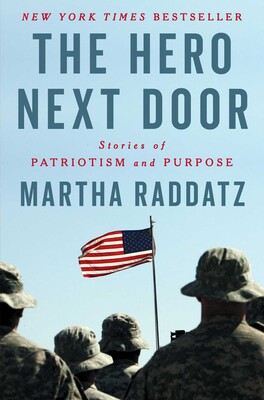
Her new book, The Hero Next Door: Stories of Patriotism and Purpose introduced me to someone I thought I already knew. It is a deeply moving collection of ordinary people who did extraordinary things in the worst circumstances war can invent, and who then dug deep to build meaningful lives out of what those circumstances left them.
From this extraordinary book, I came to see Martha as I have never have before, not only as a consummate professional but a person of deep courage, of loyalty, of profound humanity. She writes of warriors on the front lines: some pararescue jumpers or PJs, the Air Force medics who rescue wounded warriors, often at great risk to themselves; of doctors and nurses in a Baghdad Combat Support Hospital treating thousands of trauma patients; of Captain Rosemary Bryant Mariner, a tactical jet pilot who worked to enable fellow female aviators to fly in combat; of “skull cracker” Rocco Armonda, a retired U.S. Army neurosurgeon, who volunteered every year to operate in conflict zones on soldiers suffering ghastly traumatic brain injuries and, when on the home front, spent his free time soliciting donations of medical equipment, piling up in his garage, to send to Ukraine to help the grievously wounded have a chance at functional lives.
Martha’s focus includes the lives people lead after active duty. First Lieutenant Mark Little, who had both his legs blown off when his vehicle was hit by an explosive device near Baghdad, Iraq. She was at the hospital the day he was brought in and later visited him at Walter Reed Hospital. Little, who also suffered burns and traumatic brain injury, would come to lead a full life, captain of the USA Warriors Ice Hockey Team, getting advanced education at George Washington University and executive leadership education at Harvard. He would devote himself to aiding other profoundly wounded to navigate the V.A. and other systems serving veterans.
She formed long-time bonds with a small group of soldiers who in 2004 survived a horrific attack in Iraq but were deeply scarred not only by what happened to their fatally wounded buddies but what they themselves did in response to the attackers, who were mingled with women and children. This was at a time when PTSD was scarcely recognized as a war injury, leaving the friends to lean on each other, working to achieve resilience and meaningful lives after participation in a life-altering scene of carnage.
Raddatz, mother of two, was particularly drawn to certain Gold Star mothers, not just those whose children had died in war but to those who spent years nursing the fragments of human beings whom the armed forces had returned to them, never to be the same again. She describes their unconditional love, coupled with the “most selfless sacrifice” she has ever witnessed. These women, no less than their sons, are presented as heroes.
Along the way, we learn a lot about how our U.S. forces live their lives on and off the battlefield, and how the military life is a family affair. Traveling regularly into volatile war-torn zones, Martha provides fact-based accounts of front-line tactics, support logistics, medical care, bureaucratic challenges, and, later, disproportionately high suicide rates.
A reader might reasonably infer that a reporter herself might suffer from PTSD after a quarter of a century of doing these stories. Why did she embark on this course? Raddatz offers one clue: she “grew up as a fatherless, scaredy-cat little girl” who, “even at a young age, … wanted to do something to change that.” But it seems so much more than that.
She never gets into the rationale for our nation’s embarking on the various “forever wars.” She never speculates on whether they were right or wrong. Her focus is on the individuals who, from a sense of patriotic duty, give themselves (and their families) over to the mission. She credits Tom Brokaw’s masterful WWII book “The Greatest Generation” and Steven Spielberg’s later films creating greater understanding of that era’s defining wars. But her explicit goal is to celebrate the lives of unsung heroes in wars that may have had less clarity but still boiled down to individuals motivated, after 9/11, by their passion for service and resilience in caring for those who gave every last measure of their devotion.
Raddatz declares herself “a better person for knowing them.” A lesser journalist might tell such intimate stories in an exploitive way. The lifelong relationships she has developed with many of the subjects keeps her from falling into that reportorial trap.
There are up to two million active duty personnel at home and abroad, much less than one percent of the population. (Another 2.6 million are family members.) Just over six percent of Americans have ever served in the military, many of them from families with a tradition of military service. So, for the vast majority of us for whom those serving in the military has too often been a column of statistics, or a line item in an unfathomable DOD budget, we come away knowing the real lives behind the numbers. I keep returning to Rocco Armonda’s garage — the retired Army neurosurgeon quietly stacking donated equipment to ship to the wounded in Ukraine, asking no one to watch. That is the book: heroism with no audience. Prepare to be moved.
I welcome your feedback in the comments section. Click upper left to return to the home page then hit “Leave a Comment.” Book recommendations welcome. To be alerted when a new blog is posted, look for “Follow’ in the upper right portion of the home page, enter your email and click on subscribe. If you enjoy reading my blog, please share it with friends.


Fabulous!!I’m sure you sent it to Martha, but so did I – just
LikeLike