
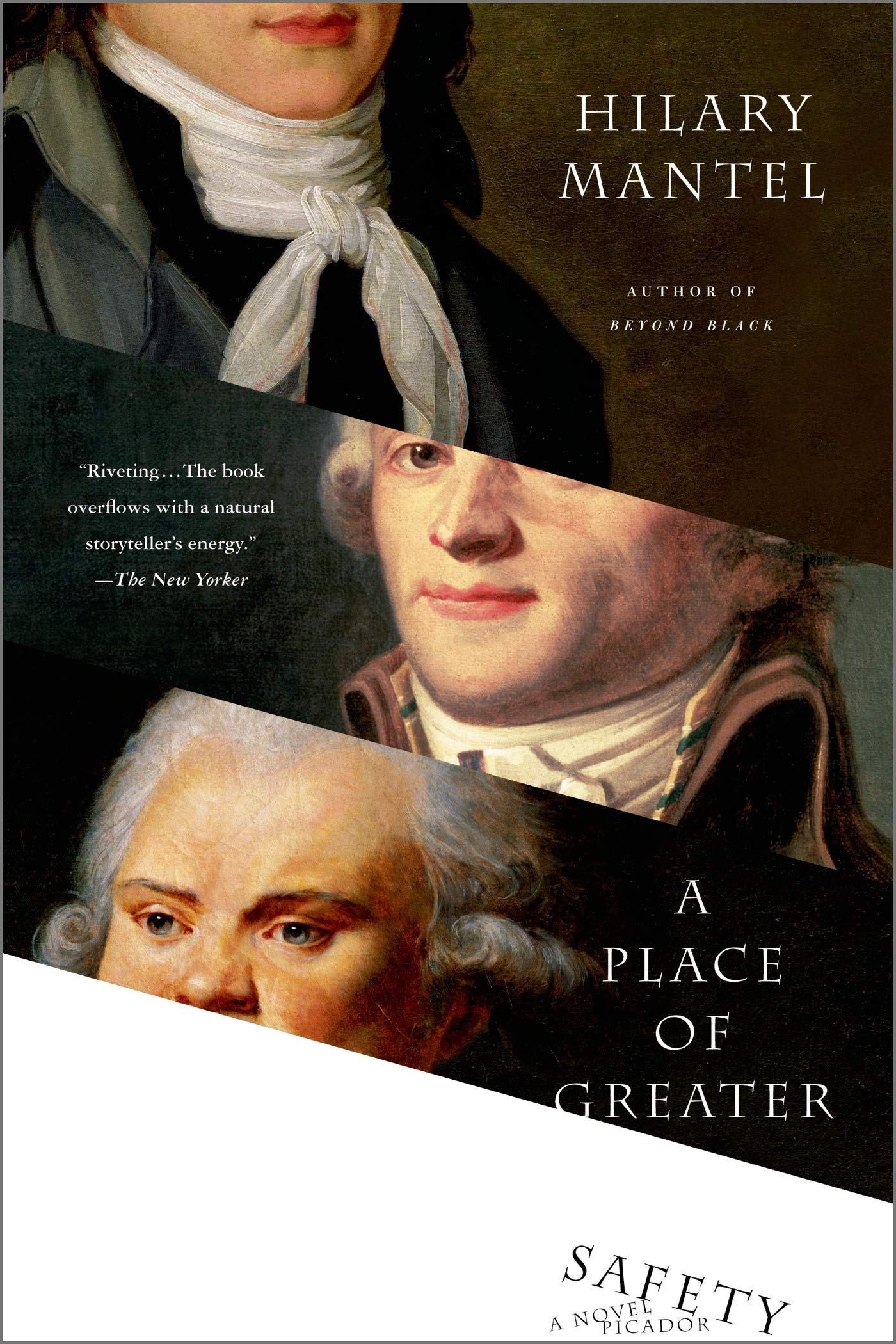
A Place of Greater Safety by Hilary Mantel. Hilary Mantel is best known for her Thomas Cromwell trilogy, Wolf Hall, Bring up the Bodies and The Mirror and the Light (2009, 2012 and 2020.) But the first novel she wrote was about The French revolution. Mantel began A Place of Greater Safety in the 1970s, before she had published anything and could not find a publisher until several of her other novels had appeared. It is the work of a writer who would later win 2 Booker prizes and be listed for a third, and it shows both her ambition and her overreach at that stage. Like the Cromwell books, it is deeply researched and grounded in real people and events. It is cinematic, laced with irony and occasional lowbrow humor and unsparing about the violence of its time. (Even the title is ironic because no one of any status was safe from the betrayals, kangaroo courts and mob violence of the time and place.)
Its three central figures, Georges Danton, Maximilien de Robespierre and Camille Desmoulins, were all lawyers by training. Connected since their youth, they were friends and sometimes rivals who helped drive the Revolution from the storming of the Bastille in 1789 through the terror of 1793 and 1794. Danton is the organizer, charismatic and pragmatic, Robespierre the austere and cerebral ideologue, Desmoulins the flamboyant journalist and pamphleteer. With others, they built a movement to replace the monarchy with a republic founded on liberty, equality, and fraternity, and then rode the movement as it ate its own. Danton and Desmoulins, who had come to call for moderation, went to the guillotine in April 1794. Robespierre followed in July, right after the novel closes.
Mantel is candid about her method. In the Author’s Note, she says her characters are real people, tied to historic facts far as those facts are agreed, “which isn’t really very far.” She picks up the famous figures earlier in their lives where the record is thin, and she admits to making “educated guesses.” She weaves in language from their writings and speeches, invents the rest of the dialogue, and anticipates “the complaints of pedants.” To readers trying to sort fact from fiction, she offers a cheerful rule: “Anything that seems particularly unlikely is probably true.” I happily went along for the ride.
I have a practical suggestion for the reader: print out the list of roughly 100 characters at the end of the book and keep it handy. But don’t be a slave to it. Let the story carry you.
What sets the novel apart from conventional historical epic is where Mantel points the camera. Much of the revolution reaches us through marriages, deaths, rivalries and friendships, and the women, Lucille Desmoulins and Gabrielle Danton especially, carry a large share of the story. Camille’s stammer runs through the book as both character trait and irony: the Revolution’s most incendiary and impactful writer can sometimes barely get a sentence out. Mantel’s Robespierre is sometimes criticized as being too sympathetic, but I read him as twisting his much-vaunted idealistic principles to rationalize injustice and even mob brutality.
The structure of this book is less sure. The book is too long. While her vivid details can add vibrancy and a sense of immediacy to the narrative, she can go overboard. We don’t need to know what every character was wearing in every scene in which he or she was present or the pallor or ruddiness of everyone’s complexion in every circumstance.
Across its more than 700 pages, Mantel intersperses the main narrative with clusters of imagined conversations and minor characters’ reactions to breaking events.(Here’s where the Cast of Characters is especially useful.) At its best, this device conveys how Parisians lived the Revolution in real time, with rumor running ahead of fact. At its worst, it confuses. She also shifts styles too often, moving among first person, third person and direct address to the reader. She comes across as a young novelist trying everything at once. They are real flaws, but not serious enough to keep a Mantel fan from plunging in.
I came to the book after Nathaniel Philbrick’s Bunker Hill, which I reviewed earlier, and it’s fun to compare how the two writers, both well researched, approach the two major revolutions. Historian Philbrick is constrained by verified written records; if information is unavailable, he skips over it. Mantel fills the silences with invented talk and interior musings. Both revolutions overthrew monarchies and proclaimed republics. The American one produced enduring institutions; the French one turned its own Revolutionary Tribunal into an instrument of repression on a scale America never witnessed. Philbrick tells you what really happened. Mantel imagines what it was like to be in the room where and when it was happening.
A Place of Greater Safety is not as controlled as the Cromwell books, nor does it try to be. It is a novelist learning, at enormous scale, how to put a reader inside history. The lessons she learned here are visible throughout Wolf Hall, and the earlier book is worth reading on its own terms by anyone drawn to this period. I am comfortable recommending it.
I welcome your feedback in the comments section. Click upper left to return to the home page then hit “Leave a Comment.” Book recommendations welcome. To be alerted when a new blog is posted, look for “Follow’ in the upper right portion of the home page, enter your email and click on subscribe. If you enjoy reading my blog, please share it with friends.

