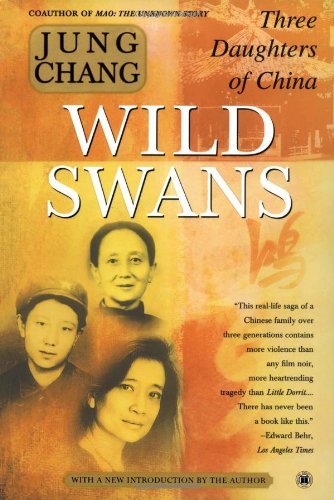
Wild Swans: Three Daughters of China by Jung Chang is a family history and autobiography of three generations of a Chinese family, spanning most of the 20th century in China. Published in 1991, the 650-page tome hadn’t come to my attention until recently. I delved in and found it fascinating. Released just after the collapse of communism in the Soviet Union and the massacre of student protesters in Tiananmen Square, Wild Swans tells the story of Chang’s grandmother, mother and herself against the backdrop of Chinese history.
Chang’s grandmother was a concubine, taken at the age of 15 as one of the several “wives” of a powerful warlord in Manchuria. She later married a highly respected doctor, and worked at keeping the family together during the war to drive the Japanese out of Manchuria and later under the hardships inflicted by Mao Zedong. The anti-Japanese Chinese were split. The Kuomintang, nationalists led by Chiang Kai Shek, were recognized as the new government of China by both the Soviet Union and the United States. Their power base was largely in the cities. The Communist stronghold was mostly in the countryside. After the Japanese were ousted, the Communists expanded and solidified their control and set about systematically persecuting the Kuomintang as counter-revolutionaries.
Author Chang’s mother was disgusted by the Kuomintang elite’s displays of wealth when others couldn’t feed their families. She became a firm believer in Mao’s communist philosophy and married Chang’s father, a poet and intellectual who became a top official in the Communist Party.
Initially the Communists redistributed land from affluent Kuomintang to peasants and provided grain and coal to the most destitute. But, as Mao became the iron-fisted patriarch, the radicalized Party set the terms not just for the politics of the country but for personal lives as well. Chang’s attachment to her mother and the rest of her family was seen as bourgeois weakness. Chang’s father was an absolutist, putting party over family and seeing suffering as the road to becoming a better communist.
Using scores of tape recordings made by her mother, Chang writes in great detail of the Communists’ betrayal of their early promises: the brutality with which they extracted party loyalty from all residents, the suffocating atmosphere of repression, deprivation of rights of speech, the barbarity unleashed by manipulating people’s hatreds, the crushing of culture, the smothering of education, and the end of individual expression in China.
The economy failed as well. Mao’s so-called “Great Leap Forward,” an attempt to move from an agrarian to an industrial society, collectivized farms and nationalized heavy industries (like steel). The program crushed food production and commerce, generating more profound poverty and famine. (At least 30 million died from starvation alone. More than that would die later from the purges of the Cultural Revolution.) Quality of health care and other benefits depended solely on status within the Communist Party.
As a student, Chang initially followed in her parents’ footsteps, but she found herself increasingly turned off by what had become the personality cult of Mao, even after Mao had reversed his brutalist economic policies. More than anything, she wanted to focus on her studies, to learn English, to read literature (some of which she subversively acquired through a black market in books.) Intellectuals were denounced as “capitalist-roaders” and sent to the country for reeducation as peasants, humiliated, subjected to beatings and worse.
Mao called on his Red Guards to smash up “old ideas, old culture, old customs and old habits.” The sixties were a reign of terror, with Mao turning against even the existing Communist hierarchy. His goal was for everyone to be indoctrinated with loyalty to him alone rather than the Party. Anyone (including the author’s father) who spoke out against what was happening would be imprisoned, tortured or killed. Chang’s father was in and out of brutal detention, sinking into psychosis for a time. Her mother, separately, was in and out of detention between 1967 and 1969. Both were kept in detention camps from ’69 through ’72.
Chang is surprisingly devoid of self-pity despite having grown up with absentee parents. As she approached her 16th birthday (in 1968), she started writing poetry. One of her brothers engaged in black market activities; another brother joined a street gang. As she puts it, over these horrific years, she said, her “indoctrination was collapsing.”
She began to see the perpetual class conflict and the misery to which the Chinese people had been subjected in a more realistic light. She goes into fascinating detail about the influence Madame Mao wielded in exacerbating the repression, especially of women, and the relentlessness of Chairman Mao in destroying centuries of Chinese culture.
After Mao’s death in 1976 and Deng Xiaoping’s “rehabilitation,” the author competed successfully for university acceptance and ultimately for the opportunity to study in the West. Her mother’s visit to her in Britain in 1988 provided the chance to learn the details of the family’s history that make this book so noteworthy
Some readers may find there are too many details bogging down the narrative. I found they just make the intensity of the privation described and the daily struggles for survival that much more real. It also makes China’s emergence today as a world-leading economic power all the more remarkable and the tenacious pattern of government repression more understandable. Wild Swans has been translated into dozens of languages, but it should come as no surprise that it is banned in mainland China.
I welcome your feedback in the comments section. Click upper left to return to the home page then hit “Leave a Comment.” Book recommendations welcome. To be alerted when a new blog is posted, look for “Follow’ in the upper right portion of the home page, enter your email and click on subscribe. If you enjoy reading my blog, please share it with friends.


I found this book fascinating as well. Thanks for your review.
LikeLike