
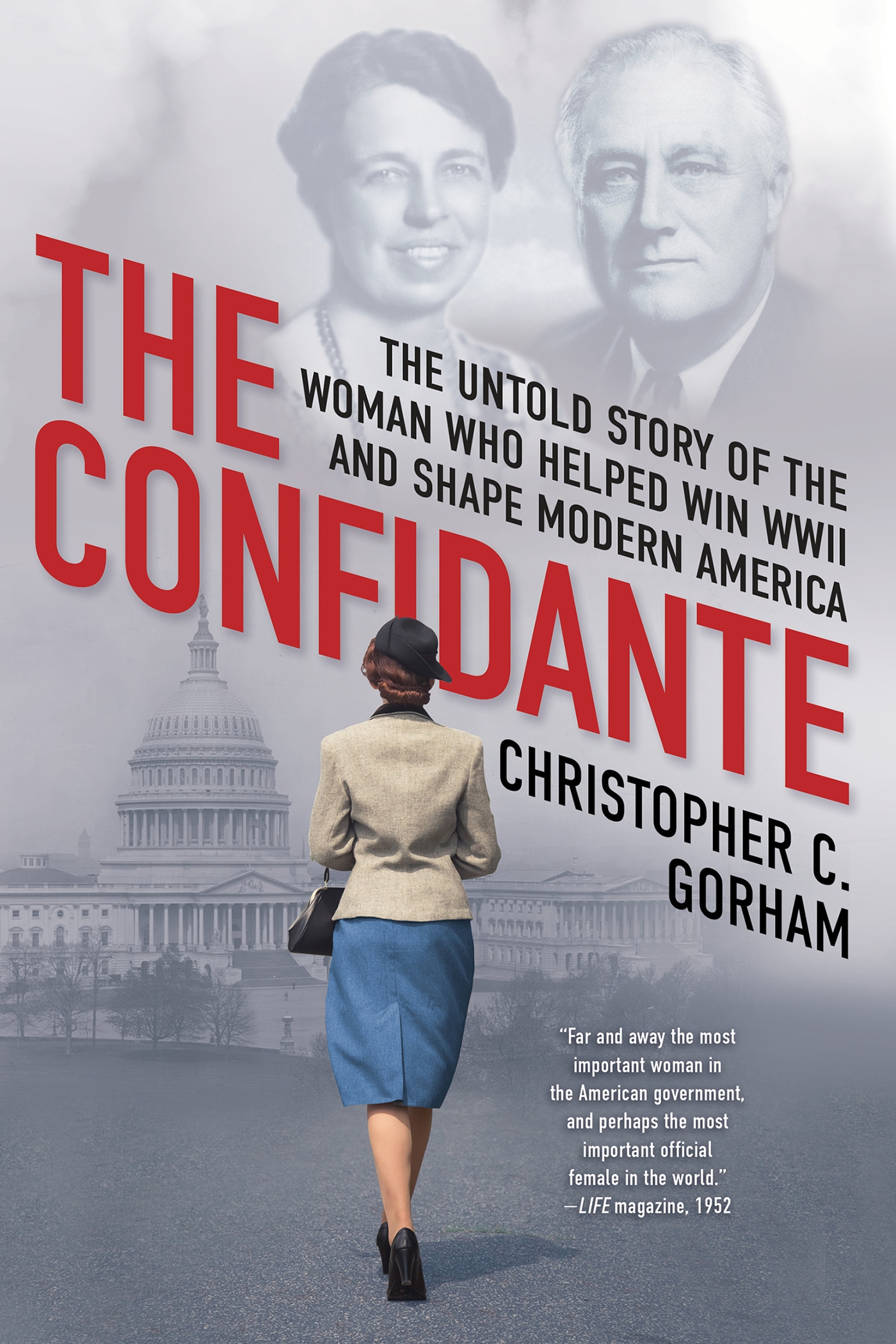
The Confidante: The Untold Story of the Woman Who Helped Win WWII and Shape Modern America by Christopher C. Gorham is extraordinary not because of the clarity of his writing or the obviously deep and meticulously footnoted research but simply because of the significance and impact of a woman unfairly forgotten today. Anna Rosenberg was a Hungarian immigrant whose parents brought her to America in 1912. She became involved in the women’s suffrage movement as a student and active in city politics, under the tutelage of Tammany Hall boss Jim Hagan. As a young woman with a talent for communications and mediation, she became skilled at problem solving and had a gift for earning the trust of labor unions as well as corporate executives. Her personal style and organizational skills eventually led to high-powered executive positions under four Presidents.
As she made her way up the ranks of the public relations business in New York, she became involved in the gubernatorial campaign of Franklin Delano Roosevelt, starting a friendship with him that would last until his death. FDR already had Frances Perkins as a labor adviser, but the reserved and stodgy Perkins, blessed with an excess of rectitude and an upper-class attitude, did not connect with regular workers the way Rosenberg did. Nor, apparently, did Perkins enjoy the close personal relationship that Rosenberg developed with FDR. Gorham notes that Perkins, in her memoir of Roosevelt, doesn’t even mention Anna Rosenberg.
Rosenberg, who also had a close working relationship with NYC Mayor Fiorello La Guardia, was stylish and warm, could swear like a Marine, and was hired to develop labor and employment programs for city and state. During the Depression, FDR tapped her to run the regional office of the National Recovery Administration. When the U.S. Supreme Court struck that down, she became regional director of the Social Security Administration. She worked with La Guardia and civil rights activist A. Philip Randolph to develop the Fair Employment Practices Commission. As a woman, a Jew, a civil rights advocate and a liberal, she became a favorite target of right-wing Senator Joseph McCarthy, who pursued her as “a Communist,” a witch hunt that continued under the newly formed House Unamerican Activities Committee. She did not bow down.
During WWII, she was a key person in the effort to build the nation’s industrial strength by facilitating the hiring of Negroes in factories like U. S. Steel. She was also involved in laying the groundwork for the integration of our armed forces. So, too, was she instrumental in moving workers on the top-secret Manhattan Project from eastern cities to Tennessee and Washington State to help with the development of the atomic bomb. Her work on the War Labor Board (organized to mediate wartime labor disputes) led to her involvement with the War Manpower Commission (tasked with balanced labor needs across industrial, agricultural and military sectors). When FDR wanted to know the impact of war on the nation’s fighting men and women, he sent Rosenberg into the war zones to talk to soldiers, just as she had talked directly with laborers during union disputes. This laid the groundwork for her work on numerous post-war demobilization programs, including the G.I. Bill.
The respect the generals had for her eventually led to her becoming General George Marshall’s Assistant Secretary of Defense, in charge of procurement, utilization and other military personnel policies. Again, the red baiters had a field day. For her part, she played a key role in the rebuilding of the depleted postwar armed forces, essential to the nation’s role in the Korean “police action.” She became the first recipient of Truman’s Medal of Freedom, the nation’s highest honor for civilian service.
Presidents Truman and Eisenhower both had engaged her in important roles. Under JFK, who had no women in his cabinet and few female top executives, Rosenberg – now living back in New York – was viewed just as a donor. As a powerful fundraiser, she organized the (in)famous Marilyn Monroe birthday party for Kennedy at Madison Square Garden. Rosenberg had supported LBJ when he was a rising young congressman from Texas, so, after the Kennedy assassination, Johnson tapped her to help drum up support for the Civil Rights Bill of 1964.
A reader today could be forgiven for a measure of ignorance about this extraordinary woman, who rose from modest beginnings to become one of the nation’s most powerful and admired women (after only Eleanor Roosevelt). She wrote no books. She worked her art of persuasion in person or on the telephone and left behind no diaries or journals. Except for an occasional magazine profile, she preferred to stay in the background, giving credit for accomplishments to others.
Many contemporaneous accounts refer to her small stature, her chic style, including bangle bracelets and a huge assortment of “perky” hats. Author Gorham defaults to that in rounding out her persona. But I’m grateful to him for this 2023 revelatory account, which fills an embarrassing gap in my knowledge and leaves me pondering who else history is overlooking as we try to understand our nation and the people who shaped who we are today.
I welcome your feedback in the comments section. Click upper left to return to the home page then hit “Leave a Comment.” Book recommendations welcome. To be alerted when a new blog is posted, look for “Follow’ in the upper right portion of the home page, enter your email and click on subscribe. If you enjoy reading my blog, please share it with friends.

