
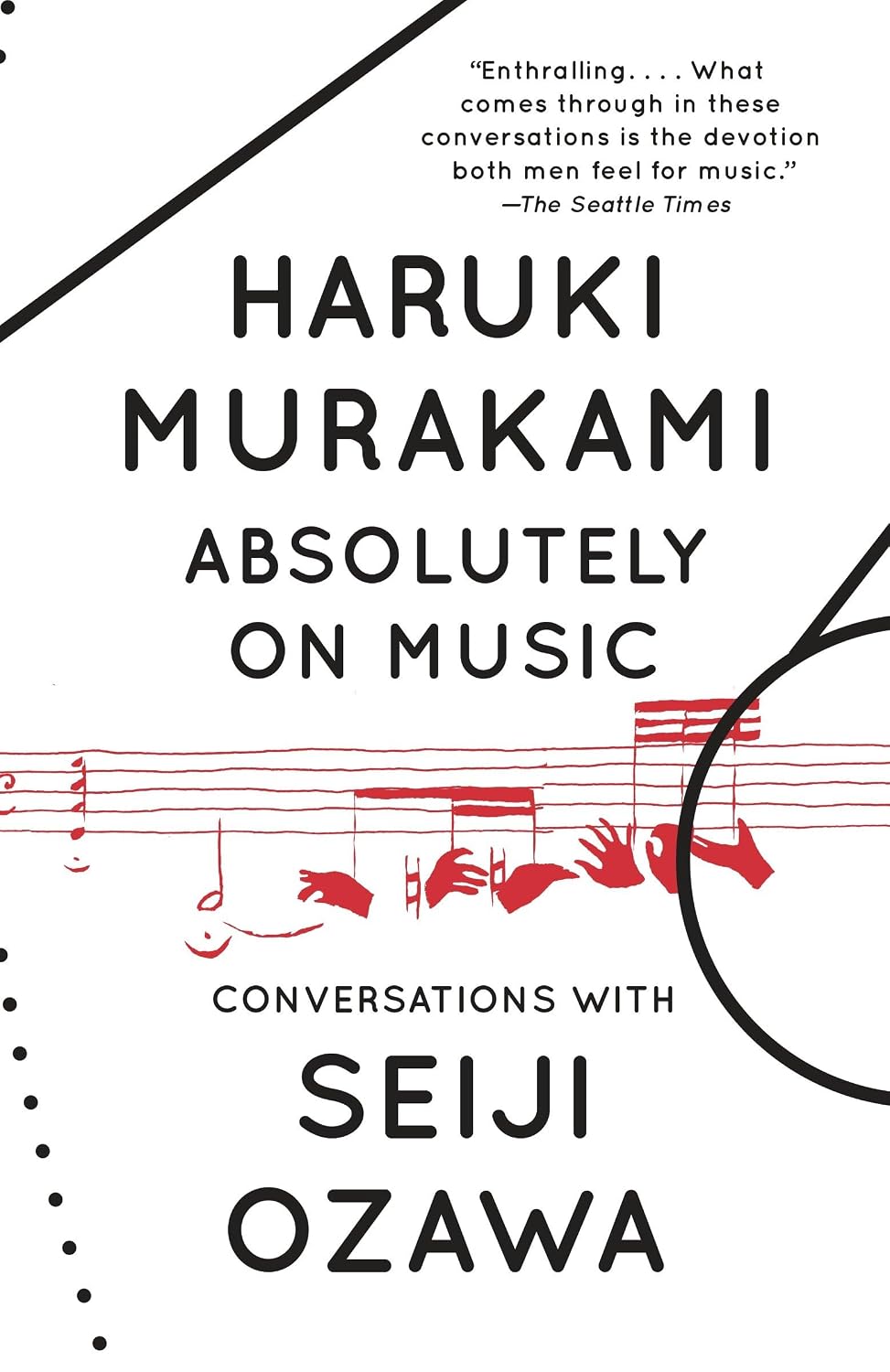
Absolutely on Music: Conversations is a gift to classical music lovers and a perfect book to read as the Boston Symphony Orchestra, having successfully resolved its contract negotiations, prepares to start its 146th season. The book comprises the recordings of a series of conversations between late BSO music director Seiji Ozawa and best-selling Japanese fiction writer Haruki Murakami. The conversations were held after Seiji’s surgery for esophageal cancer, a time when he was unable to conduct.
Murakami, whose short stories have recently captivated me, is quite learned about both jazz and classical music. The book evolved after he had gone to observe the Seiji Ozawa Music Academy, an annual project in Kyoto. The two continued their conversation afterward at a local bar and, at the suggestion of Seiji’s daughter Seira, decided to record a series of discussions. We are so blessed that the two followed her idea.
They listen to and critique different concerti and symphonies and identify the time markings of the parts of the pieces they are discussing. They note the differences in the same piece under different conductors (except perhaps for the Vienna or Berlin Philharmonic, where Seiji describes the German sound no matter who wields the baton). They also compare youthful to more mature recordings by the same conductor. Given Ozawa’s 29 years with the BSO, much attention is paid to the special quality of that orchestra. (Full disclosure: I have been on the board of advisors for more than three decades, but I keep learning more with every concert, and this book furthered by understanding immeasurably.)
The discussion prompted me to play Brahms First Symphony and Beethoven’s Third Piano Concerto, and I listened with new ears, wondering which tempo and dynamics were dictated by the score and which were the players and conductors’ interpretations. They also explore uniquely Eastern ways of playing Western music. (Here is Seiji conducting the Seito Keinin Orchestra in Japan with Mitsuko Uchida playing the Beethoven.)
When they discuss the roles of conductor and soloist in a concerto (and the question of ‘who is the boss’), Murakami and Ozawa talk about the dispute between Bernstein’s unprecedented introduction to pianist Glenn Gould’s interpretation of Brahms Piano Concerto no. 1 with the New York Philharmonic. Bernstein and Gould were at odds and made an unprecedented speech to the audience explaining why he didn’t pass off the baton to an assistant conductor. I found a recording of his speech, which I can share with you here.
There is a deep dive into Leonard Bernstein’s popularization of Gustav Mahler, and the energy and intuition that the composer and New York Phil music director brought to Mahler and his highly innovative approaches to traditional composition. We learn more about sustained phrasing, the sound of a blended orchestra versus one in which the component players are communicating with each other in a conversation. Ozawa opines that with Mahler the instruments are often “talking” simultaneously rather than in a dialogue.
Seiji and Murakami discuss the workload of a music director, starting with artistic programming. I was startled to learn that Ozawa had worked for half a century with a William Bernell, a San Francisco programmer, deciding what pieces to perform (even when the conductor was in Boston). They explored the responsibilities for choosing guest conductors and soloists, orchestra member personnel decisions, teaching and training of musicians. They reflect on the complementarity of the symphonic repertory and opera. Their conversations get down to the fine points of violinists’ bowing and oboists’ breathing.
Murakami posits that, for a writer, listening to music improves his style and that, by improving his writing style, he improves his ability to listen to music. “No one,” he says, “is going to read what you write unless it’s got rhythm.”
The back-and-forth conversations over a two-year period leave any lover of literature and music with head spinning and immense gratitude that so many of their references to scores and performances can be found on YouTube. Seiji Ozawa died in 2024, but it can easily be said that, beyond his recorded legacy, he has been kept even more alive by Haruki Murakami. Musicians and non-musicians will both find much to embrace in Absolutely on Music: Conversations.
I welcome your feedback in the comments section. Click upper left to return to the home page then hit “Leave a Comment.” Book recommendations welcome. To be alerted when a new blog is posted, look for “Follow’ in the upper right portion of the home page, enter your email and click on subscribe. If you enjoy reading my blog, please share it with friends.

