
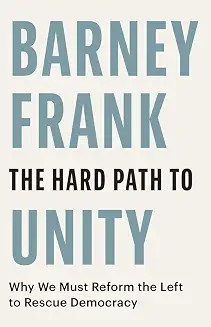
The late Barney Frank’s book, The Hard Path to Unity: Why We Must Reform the Left to Rescue Democracy, to be published September 15 by Yale University Press, is a valedictory the former Massachusetts Fourth District Congressman wrote during the last year of his life. In a sweeping broadside peppered with astute observations, he describes it as “an effort to undo the damage inflicted” by the “well intentioned but deeply flawed choices” of a Democratic left that is, he insists, “largely responsible for the political strength that xenophobic populism has come to enjoy in the developed world.” He opens with “Mea culpa,” but this is no personal apology. He assigns the guilt for this “tragic historical irony” to others on the left, especially the left of the left.
Frank’s argument is sharper than that Democrats have merely moved too far left to win. He indicts two distinct parts of the Democratic left for jointly creating the conditions in which right-wing populism could flourish. First, he maintains that, from the 1980s until recently, mainstream liberals neglected, in varying degrees, working people’s economic insecurities. Then, after Trump’s 2016 victory, self-styled progressives alienated potential allies with absolutist positions on social and cultural issues that undercut chances for electoral success. Worse, Frank argues, mainstream liberals have failed to challenge “the left wing of the left wing’s left,” letting the Republican right tar all Democrats with the most extreme positions — “defund the police,” pronoun litmus tests, open borders, and more.
Frank’s basic thesis, and the organizing principle of the book is that Democrats must offer practical solutions to the extreme concentration of wealth in this country and not subordinate that goal to a host of social transformations that are not only unpopular but will undermine both the Democratic Party and American democracy.
Frank believed his bona fides as a card-carrying progressive — battle scars earned over decades in the legislative trenches, fighting against rising income inequality and for civil rights, gay, labor and women’s rights — earned him the standing and the credibility to speak frankly to an audience not primed to hear his message.
He may have an audience. Even some more established “progressives” like Alexandra Ocasio-Cortez are reframing the posture they took in their earlier days in politics. She told ABC News recently that “Woke 1 was crazy.”
Frank writes that, when the dissident left made certain issues litmus tests for candidates, mainstream Democrats remained silent on things that were unpalatable to them, just as today too many party members have quietly allowed themselves to be defined by much of the extremist agenda of Democratic Socialists. Certainly, Republicans are only too happy to smear the whole party with the fringe call for abolishing prisons, eliminating national borders, even canceling Thanksgiving. The ensuing culture wars have fueled populist outrage and undercut mainstream efforts to address the income inequality that, Frank argues, is destroying the people’s faith in liberal democracy.
Frank, who cultivated a reputation as the smartest one in the room, is oddly lazy about his descriptive terms, and his definitions are often diffuse. Liberal democracy he defines narrowly as rule by a majority that respects the rights of minority voices. He might well have added how free and fair elections, respect for the rule of law, free press and independent judiciary – all under attack today – are key to the weakened democracy he wants to rescue.
When he aspires to address the Democratic left worldwide, the book gets muddled. He uses “the Left” too promiscuously, paying too little attention to the new democratic-socialist movement in the United States and failing to distinguish it from the substantially different labor and social-democratic parliamentary parties of Europe.
He saw the book as a response to the tragic irony that deeply flawed bad choices by the Democratic left (meaning those who are labeled progressives today) “are largely responsible for the political strength that xenophobic populism has come to enjoy in the developed world.” The grandiosity of this claim oversimplifies. There’s strong evidence that economic insecurity feeds populism — often through culture and identity — but that explains only part of whether discontent hardens into a successful radical-right movement.
To Frank, the cardinal sin of mainstream liberals here and abroad was embracing free trade, technological innovation and growing GDP while failing to address the lost jobs, stagnant wages, weakened communities and widening inequality that came with them. They mistook a growing economy for shared prosperity and served the affluent professionals and corporate titans of Hollywood, Silicon Valley and Wall Street, ignoring the growing concentrations of wealth that left working-class people behind.
Against that economic background, the far-left minority (what Frank calls the left of the left) was simultaneously pushing an extreme social agenda that mainstream Democrats (not to mention independents and others) were not ready for. One example of the lamentable social issues: the insistence of some transgender activists that male and female are no longer “valid categories.”
He faults activists for confusing the righteousness of their views with majority opinion, and for often misreading resistance as prejudice or ignorance instead of honorable disagreement. The litmus tests and simplistic slogans of the radical left are troubling enough in a primary; they are fatal when activists withhold support from the party’s nominee in a general election, effectively preferring a Republican to a Democrat who failed to check every purity box. Simultaneously, Democrats cannot gloss over legitimate immigration, crime or sex-and-gender questions merely because Republicans exploit them.
Frank’s recommendations are rooted in a deep understanding of the legislative process and a willingness to tackle problems that reflexive Democrats are often loath to discuss. From his years in government — though he did not always practice the niceties of persuasion himself — Frank understood legislative sequencing, compromise, and the moral weight of actually enacting policy.
More valuable than Frank’s turgid analysis of Keynesian economics is his insider account (as chairman of the House Financial Services Committee) of strategies enacted to save the banking system and the auto industry in the financial crisis of 2008. The lasting result was the deepening resentment in homeowners and other individuals who saw government’s role only as protecting institutions that needed protection the least. Since that crisis, voter cynicism about the efficacy of government solutions still prompts high unfavorability ratings of both parties, eroding public confidence and participation, which effective government requires.
His recurring theme is not new but remains relevant, namely, that “forging a coalition behind a broader, less politically provocative agenda is the only way to restore majority support for liberal governance.” He is not without practical solutions to the predominant sources of economic grievances, with specifics on health costs, housing and environmental regulations. As for how to pay for them, other than naming farm subsidies and the space program, he dodges cuts to be made, saying “I do not presume to dictate where cutbacks should be made,”
Frank fans will find vintage Barney aphorisms such as “cursing the darkness is more emotionally satisfying and less intellectually taxing than working out the candlepower needed to dispel it;” and “for a politician, criticizing your friends can cost more than standing up to your enemies.”
Unfortunately, he gives just two sentences to one of the thorniest issues at play in Democratic politics: the intra-party differences in attitudes toward Israel and the resulting raw antisemitism, much of it intergenerational, that threatens the party today. In his final interviews, Frank staked out a more nuanced position than this book offers, one that is neither unconditional support nor outright rejection.
His arguments are not new. The book aggregates concerns he aired for decades — excoriating neoliberals and the far left alike, advocating pragmatic legislative incrementalism. At his memorial service in May, we learned how hard the writing had become as congestive heart failure advanced and the heroic part his husband, Jim Ready, played in helping him finish. It is a small book —111 pages— that, had Frank been in better health, might have been trimmed into an essay for The Atlantic‘s Ideas section or a long op-ed. Instead, as he trigger-warned us, “redundancy is preferable to any possible ambiguity,” and the main theme returns, in slightly different dress, again and again.
In the end, the book (already somewhat dated) works as a political warning — above all on economic abandonment, cultural litmus tests and coalition discipline. He is right about ideological excess and insufficient repudiation. But the more vexing problem is that many voters simply don’t believe that existing institutions, parties or economic arrangements respond to them. Cultural overreach can worsen that crisis; moderation alone cannot cure it. (He supported the more moderate Democrats in Michigan and Maine primaries, both of whom lost.)
The Hard Path to Unity is more an epilogue from Barney Frank —his conviction about how a broad Democratic coalition must conduct itself — than a comprehensive strategy for how “the Left” can “Rescue Democracy.”
I welcome your feedback in the comments section. Click upper left to return to the home page then hit “Leave a Comment.” Book recommendations welcome. To be alerted when a new blog is posted, look for “Follow’ in the upper right portion of the home page, enter your email and click on subscribe. If you enjoy reading my blog, please share it with friends.


Thanks for highlighting this book. I totally agree with Barney snd so does Billy. I’m going to get a couple of copies, one for my grand daughter whose work is to research, present and convince Democratic leadership at the top levels of ideas and methods to win the election with winning policies and ideas. Thanks for reviewing this book and bringing it to our attention.
Connie
LikeLike