
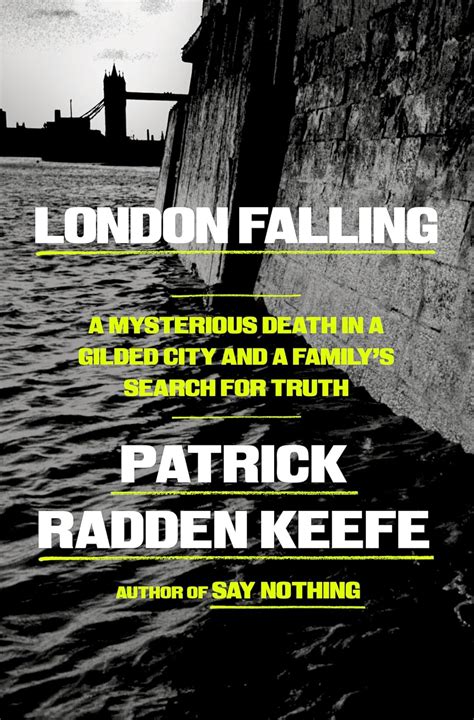
London Falling: A Mysterious Death in a Gilded City and a Family’s Search for Truth by Patrick Radden Keefe, published in April, displays once again the author’s investigative skills and journalistic talents manifest in his books Say Nothing (about “the troubles” in Northern Ireland) and Empire of Pain: The Secret History of the Sackler Dynasty (about the family behind Purdue Pharma and the marketing of oxycontin). Once again, Keefe does a meticulous deep dive into the personal stories of individuals involved in a true crime mystery against the backdrop of freshly explained British history.
Keefe sweeps across the history of London, from the disease and crime of Dickens’s world, its later primacy as a vibrant shipping center and subsequent industrial boom. We travel from the decline of its factories to its transformation from an active port city to a financial capital of the world. Wealthy Greeks arrived in London in the 1960s, and later the Saudis acquired properties that became known as “Billionaires’ Row.” The demise of the Soviet Union in the 1990’s brought to London the vast nouveau wealth of Russian oligarchs, including their laundering of “post-privatization” money through investments in luxury apartment towers like Riverwalk. London became a center of drug trade, ostentatious living, corruption and murder. It was a time of wine bars, BMWs, vacation homes, and lots and lots of cocaine and Ecstasy.
On November 29, 2019, a surveillance camera from the gleaming new MI6 building across the River Thames from the Riverwalk luxury tower picked up the image of a figure of a young man going off the fifth-floor balcony into the Thames. Did he jump, or was he pushed? Or did something else happen? Keefe spent more than two years working to find out.
In London Falling, we meet the victim, Zac Brettler, 18-year-old son of an affluent established Jewish family who had become obsessed with the vast wealth of his private school classmates, their flashy cars and watches, their lives in the fast lane. His grieving parents, financier Matthew Brettler and writer Rachelle, could never accept how quickly the Metropolitan Police closed the case as a suicide. They spent five years trying to learn the truth.
During Zac’s short lifetime, his parents never recognized their son’s narcissistic self-destructive behavior. His blurring of fantasy and reality was clearly fueled by social media. Claiming vast wealth and taking on a Russian last name, Zac talked his way into high-end real estate. He fell in with unsavory people, including, in particular, a con man pretending to be a successful entrepreneur whose empire, in reality, was built on debt. The con man’s modus operandi included serial bankruptcies, stiffing those he did business with. The more lethal of Zac’s principal “colleagues,” a man posturing as a mentor to Zac in matters of business , was in reality a major narcotics importer, an extortionist and leg-breaker not above hiring thugs to eliminate those who crossed him.
London’s Metropolitan Police Department was intent on burying the investigation of Zac’s death. There was garden variety police incompetence. Scotland Yard was drastically understaffed, and corruption was rife. Criminals had infiltrated the police, the courts, the prisons, virtually all criminal justice agencies. Refraining from vigorous prosecutions, British higher-ups didn’t want to alienate the Russian mafia, which was pumping billions into the local economy.
Patrick Radden Keefe doggedly dug into the story for two years, working with Zac’s parents who had been doing their own amateur detective work. The three spoke virtually every day. At many points, the crime story gives way to an exposition of parental grief. Keefe’s work, as always, was a masterpiece of investigative journalism. The book began as a piece in The New Yorker. The police department refused to comment offically on Keefe’s writing, but along the way some individuals on the force did manage to provide him with transcripts of interrogations, inquests, and interviews.
Heavy with detail (sometimes too heavy), Keefe still manages to present the narrative in a riveting way. In the process, he paints an eye-opening picture of London’s corrupt underbelly. Parental love keeps the search going, in the end yielding a plausible conclusion that I won’t spoil for you. This book is not as big in scope as Empire of Pain or Say Nothing. But, if you love London or if you enjoy watching procedurals, you’ll find London Falling a satisfying read.
I welcome your feedback in the comments section. Click upper left to return to the home page then hit “Leave a Comment.” Book recommendations welcome. To be alerted when a new blog is posted, look for “Follow’ in the upper right portion of the home page, enter your email and click on subscribe. If you enjoy reading my blog, please share it with friends.

