
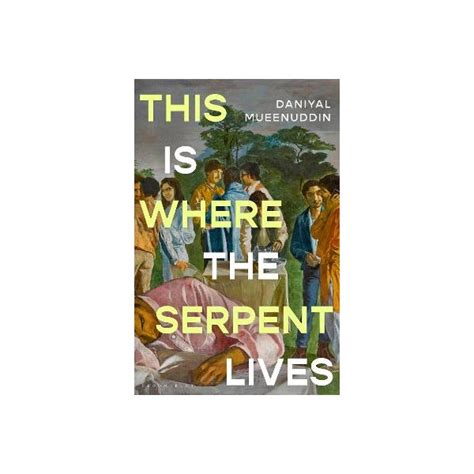
Where the Serpent Lives by Daniyal Mueenuddin, is a totally captivating novel starting in 1950’s Pakistan, colored by the caste system that frames the past, present and even future for its people. The backdrop is the turbulence following Partition, the 1947 separation of Pakistan from India. The story continues through 2013.
In a gripping beginning, a little boy has been abandoned by his mother in the bazaar of Rawalpindi. Barefoot, he sits clutching to his chest a pair of shoes, waiting, waiting for her to return for him. Ultimately he is taken in by Karim Khan, the kindly operator of a tea stall and curry shop, who creates a space for him to sleep in a former store room. Karim teaches him to do small chores and names the boy Bayazid. As the years pass, Yazid takes on more and more tasks for his guardian. Karim himself is illiterate, but Yazid teaches himself to read. He makes friends with comfortable middle class boys from a nearby private school, and, at 14, he becomes infatuated with the sister of one of them. But class differences mean the relationship is not to be.
The book, published in January, then jumps to the countryside, feudal in its social and power structure, and a wealthy family one of whose properties is a huge farm just outside of Lahore. Mueenuddin, who attended Dartmouth and Yale Law School, is himself the son of a family with a farm outside Lahore and splits his time between there and a home in Oslo.
In the second section of the book, he introduces the reader to a whole other set of colorful characters. There are the super-rich who jet off to city parties in Pakistan and beyond, who sleep with the wives of their friends and indulge in drugs and porn. Then there are the hired managers of their properties (munshis) who enrich themselves by skimming off the top of the family-owned businesses, the underpaid laborers whom the munshis influence by threats and violence, and the corrupt Punjab police who extort vendors and low-level business people, with tools of persuasion that include brutal torture.
Chapters later, we meet again the orphan Yazid. Now a mature man, grown tall and muscular, approaching middle age, he is in the employ of that wealthy family, first as the trusted chauffeur of Colonel Atar, a powerful industrialist and member of the government, and – after years of proving himself – working for Atar’s son Hisham and daughter-in-law, Shahnaz.
Yazid, now enjoying access to the world of the wealthy and widely respected in the nearby villages, takes under his wing a young man named Saqid, son of the trusted gardener on the estate. But Saqib is impatient to become rich and is willing to cut corners to achieve, even if that means betraying the trust of his mentor Yazid, his employers, and the economic and cultural system that has permitted him a level of advancement based on his intellect and apparent business acuity.
Mueenuddin’s character portrayals are intimate and enticing, many drawn from his own personal background. His Pakistani father was a diplomat and landowner. Despite the author’s upper class status, he writes with deep empathy and understanding of the plight of the underclass. In an interview, Mueenuddin says he modeled Yazid on a man who drove for his father and was his companion when he was a youth. Collections of Mueenuddin’s short stories were finalists for the Pulitzer and National Book awards in 2009 and 2010.
His use of language is colorful and polished, bringing the reader equally into the geographical landscapes and the interior of his characters. His storytelling is brilliantly crafted, and his saga is spellbinding, raising questions that will gnaw at you long after the book is closed.
What are the rules of the discriminatory system within which one can advance but just so far? How can a code of morality still matter within a corrupt and violent country? How far can one go in playing the system without self-destructing? This is a remarkable book, taking the reader to places one sees only in simplistic headlines, if at all. It will stay with you for a long time.
I welcome your feedback in the comments section. Click upper left to return to the home page then hit “Leave a Comment.” Book recommendations welcome. To be alerted when a new blog is posted, look for “Follow’ in the upper right portion of the home page, enter your email and click on subscribe. If you enjoy reading my blog, please share it with friends.

