
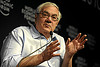
The year was 1976. It was nearing deadline time at the The Boston Phoenix. Editor Bill Miller, formerly of the Boston Globe, emerged into the newsroom from his small office. A hush fell as reporters turned to face him. Waving his hand in the air, Miller announced, “A hundred dollars to the first reporter who can write a piece without quoting Barney Frank!”
Barney was nothing if not quotable. He was quick, and he was devastatingly funny. He was also irascible, arrogant, dismissive, and, according to some who worked for him, downright mean. He didn’t suffer fools lightly, or anyone else for that matter. He was a master of the put-down. Very late one snowy presidential primary election night, he and I stood nearly alone outside the Copley Plaza and engaged. He was furious about something I had co-written (with Jim Barron) about a candidate he was backing. He haughtily misrepresented the article, scornfully criticizing things we had never said. I defended what we wrote. Barney continued his attack, contemptuously ascribing dark motives to us. Finally, as the snow got heavier, I said in exasperation, “Barney, you are one of the most arrogant people I know.” “Really, Marge?” he retorted. “How many arrogant people do you know?” I have chuckled about his quip for decades.
When he retired from Congress in 2012, I called him “the rudest Congressman you’ll ever miss.” What he was as well was a brilliant legislator, who knew how to get things done. Passionate about the issues he cared about, especially civil rights, he wasn’t afraid to be pragmatic. The Dodd-Frank Wall Street Reform and Consumer Protection Act of 2010 was a major piece of work to bolster the economy in the aftermath of the 2008 financial crisis. Its purpose was to prevent future financial catastrophes. He worked hard, as leader of the House Financial Services Committee, to provide money for housing and access to credit.
Like Ted Kennedy, Barney knew when to depart from liberal dogma, and he could reach across the aisle to get a deal done. From trucking deregulation (which I worked with him on for the PBS show The Advocates) to Dodd-Frank, he rejected knee-jerk positions. He was an expert in working the legislative process in a way that has disappeared from D.C. He also had a libertarian streak, curiously opposing data privacy protections and supporting widespread online gambling. (If we saw him this summer in Ogonquit, I planned to get his opinion on today’s excess of sports gambling.) During his four terms in the state legislature, he advocated for the legalization of prostitution in a Red Light District in downtown Boston.
When the Dukakis administration launched a successful effort to depress the Central Artery that cut through Boston, Barney eviscerated the idea by saying that, rather than depress the Artery, it would be “easier to raise the city.” His contempt for many others’ ideas was amplified by his fashion style. He was a slob. I once saw him wearing a jacket ripped down the back at the seam. He explained that he had just flown in and hadn’t had time to change, but the next day at a different event he was wearing the same split jacket. The only time I saw him care about his appearance was during a taping of The Advocates when Barney had us send interns out to buy a fresh shirt for him because his mother, Elsie Frank, was going to be in the audience. In his first bid for state legislature, he ran – and won – on the slogan “neatness isn’t everything.”
Nor, it seems, was niceness. A Massachusetts visitor to Barney’s Washington office told me he was appalled that the Congressman read a newspaper while he presented his case on a pressing issue. When I was producing a series of election debates at WCVB-TV, Channel 5, we asked all candidates to arrive at the station half an hour before the candidates in his race were to debate. He berated me for asking him to come early, saying he wasn’t in nursery school and could show up when his debate was to begin and not a minute sooner. Saying please and thank you was an unnatural act for Barney. When he wanted favors of others, he would ask his aide or others to act as an intermediary.
The people in the Massachusetts 4th congressional district came to view his rudeness as the price they had to pay for his hard work, wit, intellect and his attentiveness to the bread-and-butter issues of his district. Voters sent him to Washington 16 times. When he retired, he said that one of the benefits was that he would no longer have to be nice to people he didn’t like or even schmooze with constituents.
A closeted gay until 1987 (though many had figured it out long before), he came out in response to a question from a Globe reporter and became the first openly gay member of Congress. He was also the first gay in Congress to marry his longtime partner, Jim Ready. If Barney had come out sooner, he might have avoided the events that led to his 1990 408-18-vote reprimand on the floor of the House. His involvement with prostitute Steve Gobie, who claimed he had run a prostitution ring out of Barney’s house in the mid eighties, and Barney’s fixing parking tickets for Gobie and misusing his office to get modified the terms of Gobie’s probation were a low point to Frank’s long career. After the humiliating reprimand, he won reelection by a two-to-one margin but said goodbye to his dream of becoming the first Jewish House Speaker.
Barney was a fighter to the end. Shortly before his death this week at 86, he was finishing a book entitled The Hard Path to Unity: Why We Must Reform the Left to Rescue Democracy. In the book, to be published in September, he warned the Democratic Party to reject political correctness and unrealistic policies. In his last interview on WBUR, he cited problematic litmus issues: “Open borders is one. Defunding the police would be another, along with insistence on political correctness and transgender participation in girls’ sports. And environmental issues like the Green New Deal — they just go too far.” In Politico, he said he was hoping to use his “reputation and my record of being on the left to give courage to many of my colleagues who I know agree with me but are inhibited from saying so.”
Barney Frank will be remembered for his protecting consumers and homeowners from predatory business practices, his leadership on gay, civil and women’s rights, his biting wit, and, oh yes, did I mention his rudeness — even to his friends?
I welcome your feedback in the comments section. Click upper left to return to the home page then hit “Leave a Comment.” Book recommendations welcome. To be alerted when a new blog is posted, look for “Follow’ in the upper right portion of the home page, enter your email and click on subscribe. If you enjoy reading my blog, please share it with friends.


Hi Marjorie Excellent artic
LikeLike
Barney Frank was privileged to have been able to work with you, Margie!
LikeLike
David, That is a lovely thought. Both he and I would be surprised to hear that!
LikeLike
Barney Frank was lucky to have had the privilege of working with you, Margie!
LikeLike