
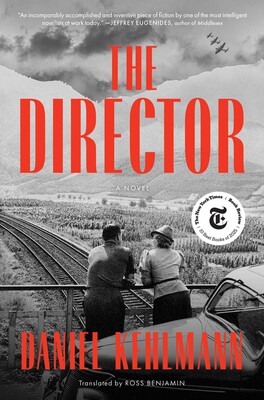
The Director by Daniel Kehlmann is a challenging but intriguing work of fiction. Its surreal and expressionistic style focuses on its characters’ dreamlike experiences and emotional journeys. These stylistic elements mix with realism as the narrative develops, prompting this reader to appreciate the author’s stunning talent and creativity.
This historical novel is based mostly on many real-life individuals during WWII. The principal character is Weimar film director G. W. Pabst, who is introduced to us in the beginning by his fictional associate Franz Wilzek. Wilzek has been brought out of what is apparently a memory unit at an American retirement home to be interviewed about Pabst in a live television program. Not surprisingly, Wilzek’s memories are unreliable, and the interview is a bust. But the introduction to these film makers is made. We next meet the German-speaking Pabst back in the early ‘30’s at a Hollywood party where he is hard put to understand the English conversation swirling around him. The effect of his confusion is somewhat surreal.
Cut to Austria just after the Anschluss, when Pabst, his wife Trude and (fictional) son Jakob have returned to visit his dying mother. The borders close, and they are trapped. Director Pabst had gotten his start in silent films. He managed a successful transition when the talkies came in. Among the real-life actors with whom he worked were Louise Brooks, with whom he had an affair, and Greta Garbo. Nazi propaganda film maker Leni Riefenstahl shows up in the novel, as well as actor Werner Krauss, star in horror movie Dr. Caligari and in antisemitic propaganda cinema. All are woven into this story.
Pabst’s work was controlled by a Ministry of Film that was under Joseph Goebbels’ Ministry of Propaganda. In the fraught environment of his time, he was an accomplished director and screenwriter and a master of modernistic film editing. His decision not to try to escape to the United States led to the tarnishing of his reputation. Instead, Pabst stayed in Europe, traveling back and forth among Berlin, Vienna, and Prague, with the war all around him and closing in. Author Kehlmann gets into Pabst’s head as the director struggles with Goebbels’ censorship and other compromises required of him if he is to keep working.
When the Soviets push Germany back, Red officers come to arrest Pabst for having created Nazi films. He plies them with vodka, telling them that he had once been a Communist, known as Red Pabst. They are charmed and persuaded, and they all part as friends. The surrealism continues.
Kehlmann’s fictional Jakob, teenaged son of Pabst and Trude, has learned from boarding school that, to avoid being bullied, he has to become an aggressor. Not surprisingly, he joins a Hitler youth group and later makes it into the German Wehrmacht. He is willing to die for “something greater than ourselves. For the Reich and for our Fuhrer.”
Franz Wilzek, whom we met at the very beginning as an addled old man, returns as a much younger man to play an important role in the twists and turns of the novel, right up to the very end.
This is not an easy book to read, given its style, likely reminiscent of many of Pabst’s films. The narrative voice is omniscient, delving deep into the psyches and interior dialogues of the principal figures. Which characters are fictional, and which are real? What events are truly happening, and which occur only in the characters’ dreams and nightmares? What is the point at which the characters’ compromises for survival make them complicit in the system of the Third Reich?
W. G. Pabst is asked if it isn’t strange to continue working through the horrors of Nazi Europe. He replies that “times are always strange. Art is always out of place. Always unnecessary when it’s made. And later, when you look back, it’s the only thing that mattered.”
Readers of The Director are left wondering: did these artists make films at that time that really mattered, or did their failure to defy simply validate Hitler and his thugs? What is the responsibility of artists during times like our own to speak out against authoritarianism? Or, are they better off producing art that distracts us and numbs us to the undermining of democracy on the home front?
I welcome your feedback in the comments section. Click upper left to return to the home page then hit “Leave a Comment.” Book recommendations welcome. To be alerted when a new blog is posted, look for “Follow’ in the upper right portion of the home page, enter your email and click on subscribe. If you enjoy reading my blog, please share it with friends.

