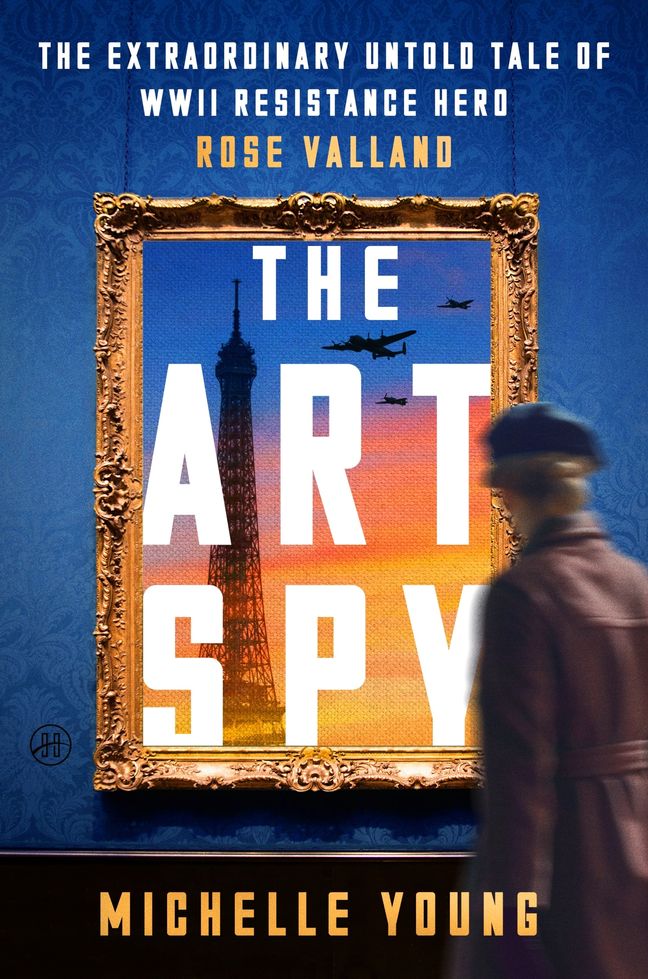
The Art Spy: The Extraordinary Untold Tale of WWII Resistance Hero Rose Valland by Michelle Young is a richly researched account of an apparently nondescript art historian who rose from a low-level volunteer job just prior to the Second World War to a preeminent curatorial position at the Jeu de Paume Museum in Paris. There, her photographic memory, attention to detail, immaculate record keeping and steely courage fortified her commitment to keeping Hitler and his legions from looting priceless French masterpieces during the war.
Rose Valland’s reserved demeanor belied her ferocity as a courageous protector of the nation’s cultural patrimony. As the war in Europe ramped up, she devised a complicated plan to surreptitiously ship sculptures and paintings to various chateaus in the Loire Valley and beyond. Many of the treasures would remain hidden until Germany was defeated. Some have yet to be found.
When the Germans occupied Paris and the Nazis seized the Jeu de Paume, Valland stayed in place. Her official assignment became monitoring the facility, its heating system, plumbing and infrastructure. The Nazis used the museum as a repository for art treasures they were stealing from France and across Europe, not just from museums and galleries but from private collections like those of the Rothschilds, Paul Rosenberg and Adolphe Schloss. They systematically plundered the collections of Jews who had fled or been killed, their possessions now conveniently labeled “abandoned property.” The booty was destined for Hitler’s planned Fuhrermuseum in Linz, Austria, but the Fuhrer’s henchmen, especially Reichsmarschall Herman Goering and other high-level Nazis, were skimming thousands of irreplaceable works of art from the Jeu de Paume, the Louvre and elsewhere.
Rose Volland was required to curate exhibitions for visits by Goering and other powerful Nazis seeking to add to their personal collections. Secretly, she kept meticulous notes, often just on small scraps of paper, cataloguing the provenance of art works, recording the specific locations to which the Germans were shipping their selections. She was thus able to track the movements of German officials and convey the information to the French resistance.
The Germans (Hitler especially) viewed modern artists (e.g., Picasso, Matisse, Braque) as “degenerate,” but they didn’t hesitate to confiscate many of those works because they could be sold for money to help finance Germany’s war efforts. Other works, sadly, were mutilated or burned.
Periodically, Rose would be interrogated, and occasionally she was ejected from the museum, only to talk her way back in. She often slept on a straw mattress in the museum to protect its holdings. Overnight, she would secretly copy German inventory. Her life was increasingly in danger toward the end of the war though, as a closeted lesbian, she would all along have been a target for elimination by the Reich.
Some of her subversive activities are worthy of a LeCarre novel, and they are cinematically told by author Young.
Valland’s efforts did not stop after 1945. After the war, she was made General Secretary to the Commission for the Restitution of Art. Her work took her to Germany to locate the pillage. She held the rank of Captain. Thanks to her record-keeping, she was able to facilitate the return of many stolen art treasures to their rightful owners. She was also able to provide concrete evidence of the crimes at the Nuremberg trials.
Rose Valland became one of the most decorated women in French history. There are streets and squares named after her, as is a non-profit institution dedicated to restitution of stolen art. She appears in The Monuments Men (film and book.) Valland is one of the characters in Lynn Nicholas’s book The Rape of Europa. The Art Spy is distinguished by Michelle Young’s deep dig into Valland’s life: her professional battles against misogyny blocking her advancement in the art field and muting her post-war recognition, the perils she faced as a spy, her ingenuity in outwitting the enemy, her infinite patience and seemingly bottomless reservoir of courage.
The depth and breadth of Young’s research is stunning, and a reader would do well to examine the notes in this important book. Beyond Rose’s own copious notes, she had exchanged many letters with prominent figures in the art world, government officials, friends and family. Her correspondence with Jacques Jaujard, head of France’s national museums, was voluminous. Young found historians’ reports and bureaucrats’ papers, public and private, court records, transport records, museum catalogues and library archives, personal diaries and magazines, in Europe and from America. The book’s details are put together seamlessly, with intrigue and revelations at every bend in the narrative.
I welcome your feedback in the comments section. Click upper left to return to the home page then hit “Leave a Comment.” Book recommendations welcome. To be alerted when a new blog is posted, look for “Follow’ in the upper right portion of the home page, enter your email and click on subscribe. If you enjoy reading my blog, please share it with friends.

