
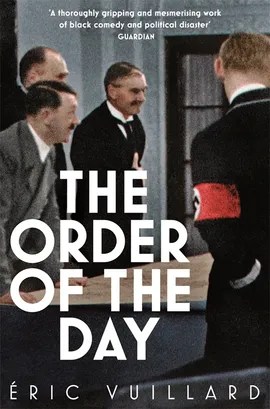
The Order of the Day by award-winning French novelist and film maker Eric Vuillard is a well-researched and creatively presented story of the Anschluss, Hitler’s move to take over Austria and incorporate it into Germany. It is a brief cautionary tale in narrative non-fiction form.
Where direct quotes are available, Vuillard uses them. Where they are not, Vuillard draws on memoirs, journals, court testimony, interviews and photographs to create conversations as he imagines them to have taken place. We see the gestures and personal peculiarities of the speakers, their clothing styles, the interior designs of halls where high-level meetings were held. We feel characters’ anxieties, fears, and frustrations.
The book opens in 1933, when then-Reichstag President Hermann Goering gathers 24 corporate chieftains (think Krupp, Siemens, Opel, BASF, Telefunken, Reichsbank) around a table to lay out the urgency of Hitler’s plan to consolidate power. The upcoming elections are important, he tells them, to ward off the Communist menace, end trade unions, and consolidate their own power as mini fuehrers in their own companies. Goering even jokes that these may be the last German elections for a century. A reader can’t help feeling that the invitees look very much like today’s oligarchs, captains of industry like Elon Musk, Mark Zuckerberg, Peter Thiel, Jeff Bezos, and others. They go where the power is and fork over the money to ensure their personal success.
As if to make the point, Vuillard observes that “corruption is an irreducible line item in the budget of large companies, and it goes by several names: lobbying fees, gifts, political contributions.” The corporate types who had funded Hitler’s electoral success not only stood by as he executed his evil plans, but, by using concentration camp prisoners as forced labor in their factories, they became even wealthier.
The major focus of this short (140 pages) book is March 12, 1938 when Hitler marched into Austria, having bullied then-Chancellor Kurt Schuschnigg to sign a document agreeing to be absorbed by Germany, having threatened military action if Austria failed to comply. Leading up to that day, Vuillard describes British Prime Minister Neville Chamberlain’s appeasement strategy and the denial and timidity of the rest of European leaders. None of them was unaware of the Nazis’ brutal actions: the burning of the Reichstag, opening up of Dachau, sterilization of the mentally ill, the many atrocities to achieve racial purity, the purge of political opponents.
Vuillard cinematically describes a confrontation between Hitler and Austrian Chancellor Kurt Schuschnigg, who tried to stave off the inevitable by persuading the Germans that he has always maintained policies friendly to the Reich. Hitler screams his disagreement. Then the Fuehrer’s mood becomes childish and he tells Schuschnigg that he, Hitler, is going to build the largest bridge in the world. He goes on to say he’ll put up the tallest buildings, bigger even than America’s. (Sound like any official that you know?) Vuillard calls Hitler as “virulent as a gob of phlegm,” which kind of sticks with the reader. Hitler, he writes, is beyond any objections of constitutional law.
Other major characters are Nazi war criminals Arthur Seyss-Inquart, who shares Hitler’s talent for blunt threats and repetitious propaganda, and Foreign Minister Joachim von Ribbentrop, who just happened to rent a flat from Neville Chamberlain in London.
Nowhere does Vuillard say that Trump is a Hitler, nor does he specifically warn of events in our own day. But it’s impossible not to see parallels to some of Trump’s behavior: the authoritarian actions, megalomania, braggadocio, thirst for revenge, and disregard for constitutional precepts, values, and norms.
Also resonant are the appeasers, the oligarchs, the sycophants, and, yes, those who shut their ears and eyes and hunker down in the comfort of their daily lives.
Written in 2017 and winner of the Prix Goncourt, France’s most prestigious literary award, Eric Vuillard’s book stimulates pressing questions about how far down the road to authoritarianism the United States has already traveled and who is leading us down that path to the detriment of democracy. Readers may balk at the author’s preachy inserts, but there is a much-needed sermon in the story he is telling.
I welcome your feedback in the comments section. Click upper left to return to the home page then hit “Leave a Comment.” Book recommendations welcome. To be alerted when a new blog is posted, look for “Follow’ in the upper right portion of the home page, enter your email and click on subscribe. If you enjoy reading my blog, please share it with friends.


Knowing history enables people to make wiser decisions in the present. Thanks for reviewing this book.
LikeLike