
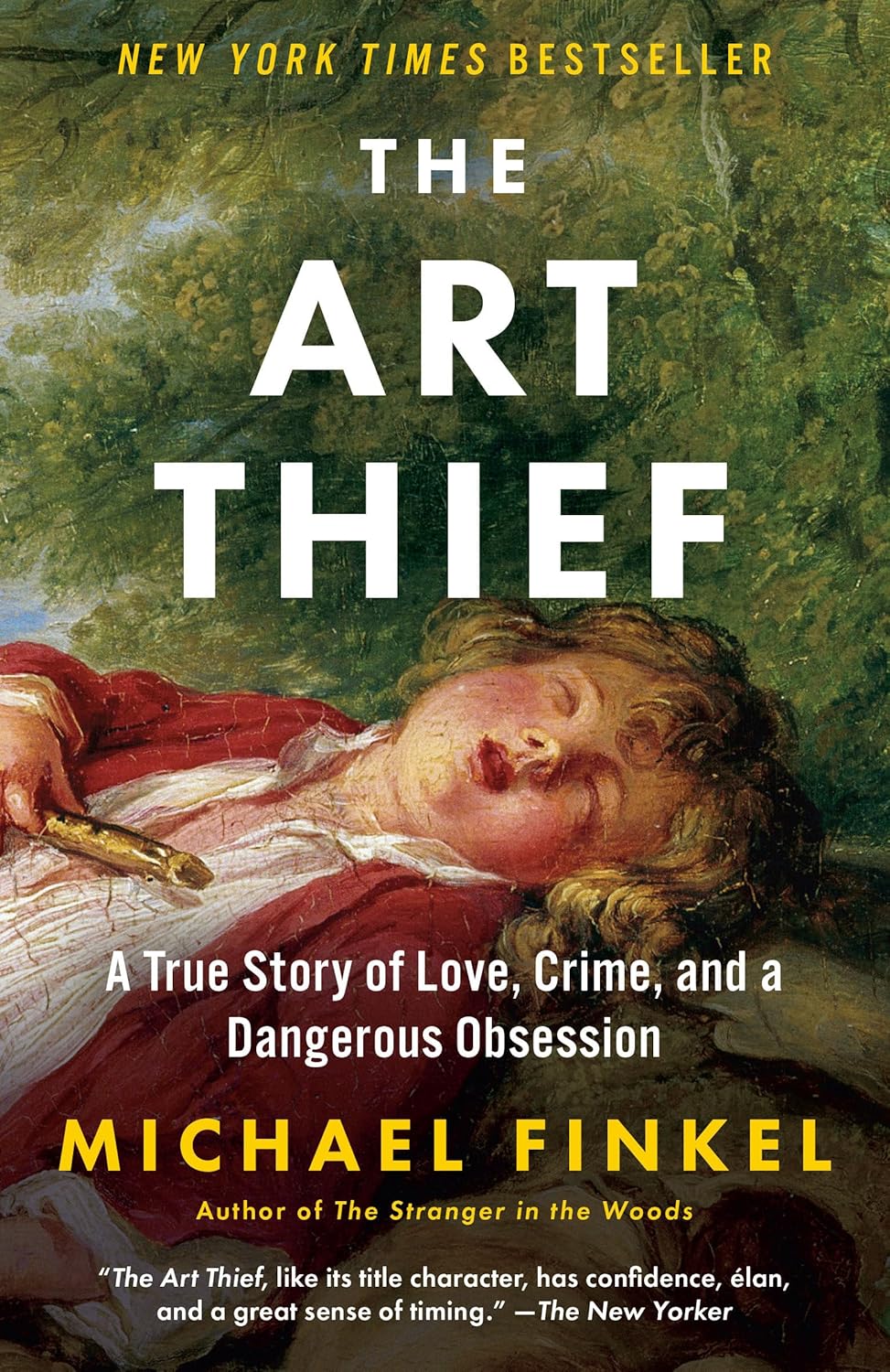
The Art Thief: a True Story of Love, Crime and a Dangerous Obsession by Michael Finkel, published in 2023, is a well researched and documented account of one of the most unusual art thieves of all time. For years, his heists stymied collectors and investigators in Europe, especially in France, Switzerland and Germany. And he did his crimes for the love of art!
Stéphane Bréitwieser was born in 1971 in the Alsace-Lorraine region of France, bordering on Germany and Switzerland. He was fluent in French and German, and was functional in the mixed (Alsatian) dialect and English. His parents were affluent; their resplendent home had a significant art collection, which Stéphane took pleasure in even as a boy.
When his parents divorced, his father took with him all of the home’s paintings, antique objects and collectibles, leaving an emotional hole in his psyche. Stéphane lived with his doting mother, Mireille Stengel, but spent much time with his grandfather, Joseph Stengel, who took him walking through old Roman ruins in the Rhine Valley. Thus began a lifelong obsession with collecting small artifacts. As an oddball teenager, Stéphane’s interests were archaeology, medieval pottery, old architecture and Hellenic history. He was, as Finkel puts it, “born in the wrong century.”
Deprived by his father of so many of the material objects that resonated with him emotionally, adolescent Stéphane took up shoplifting, from clothes, to books, to whatever caught his fancy. Psychologists made clear he was trying to fill the void left by his father. Punishment – forced apologies, paying compensation, even a court-ordered stay at a behavioral therapy clinic – never curbed Stéphane’s insatiable drive for acquiring and collecting things.
He took small jobs, often menial, and spent the rest of his time in and out of museums, studying art and history. For a month he got a job as a security guard at the Mulhouse History Museum, where he learned about the procedures for security – or lack thereof. He quickly became bored with the regularity of a job.
By the time he turned 20, he had acquired something else of beauty, a girlfriend. His new love, Anne-Catherine Kleinklaus, was not bothered by his shoplifting, and even seems to have shared his exhilaration for it. She moved into his room on the top floor of his mother’s house and soon became his accomplice. In 1991, he stole a priceless hammered metal belt buckle from 500 AD and, in 1994, a flintlock pistol from the early 18th century. His father had flintlocks, but this one was nicer. Stealing it, he said, “was the ultimate ‘fuck you’ to my dad.”
Together, they moved from one small museum to another in that part of Europe, graduating from small objects to stealing paintings, especially 16th and 17th century Renaissance and Baroque artists. With Anne-Catherine as his look-out, Bréitwieser would use a Swiss Army knife and other small tools to separate paintings from their frames, hiding them inside his raincoat as they strolled past security guards and out to their car. Some thefts took place in daylight, even when museums were crowded. He would go on to become what Finkel describes as the world’s most prolific art thief. He had lifted more than 200 pieces, worth, according to Finkel, an estimated $2 billion. ARTnews Magazine puts the value at $1 billion, and faults Finkel for building up a mythology around Bréitwieser.
What differentiated him from other art thieves was that he did his crimes for pure psychological gratification. Surrounding himself with objects of beauty gave him inner joy. His intent , at least initially, was not to sell them for money but to cherish them. The act of stealing them gave him a high. He kept them in the attic of his mother’s house, where his mother respected the young couple’s privacy. (For years, she would claim not to have known of his crimes.)
He long escaped detection because he never tried to fence these priceless possessions. He was brought to court in 1997 when he and Anne-Catherine were recognized by a Swiss gallery owner. Because the police took him for a first-time offender, he got away with a suspended sentence. He was arrested again in 2001. By this time, his now fully aware mother destroyed many of the works in his collection to cover up evidence of her son’s crimes. She burned many valuable paintings and tossed remnants of collectibles in the nearby Rhone-Rhine Canal, where they came to public attention when pieces floated to the surface. She got three years for receiving stolen goods but served half the time. Anne-Catherine got 18 months but served six months.
For Stéphane, it was rinse and repeat. More arrests followed more thefts. Two years in prison in Switzerland were followed by a sentence of three years imprisonment in France, of which he served 26 months. In 2006, he wrote an autobiography entitled “Confessions of an Art Thief,” but it was not a financial success.
Eventually, closely monitored by arts police in several countries, he devolved to surviving on monthly welfare payments reduced by token amounts subtracted for court-imposed fines. In defiance of his self-identification as a sophisticated art connoisseur “with unusual acquisition methods,” he then started to fence some of his newly stolen pieces. He had become just another art thief, on trial yet again in 2023.
Author Finkel spent a decade gathering pieces of the story, pursuing Bréitwieser for an interview from 2012 to 2017, when he finally was able to meet with him for a total of 40 hours. Finkel also used court records and secondary interviews but was refused interviews by Stéphane’s mother and girlfriend.
His book provides several high points in the history of art theft, including the 1911 theft of the Mona Lisa (eventually returned to the Louvre), the dozens of heists executed by Massachusetts’ own Myles Connor in the 60’s and 70’s, and the Gardner heist in 1990. Breitweiser, himself, observed that “the story of art is the story of stealing.” More than one museum director might acknowledge the same.
Finkel covers everything from the economics of the stolen art market to some speculation about the neuroscience of impulse-control disorders that created Bréitwieser’s unstoppable criminal behavior. (He even stole a brochure from a gift shop while in Finkel’s presence.) He’s apparently still under house arrest, with only government assistance to live on.
Despite criticism that Finkel relied too heavily on Bréitwieser’s views, “The Art Thief” is a richly detailed piece of non-fiction, a true-crime psychological thriller of sorts, and a well-executed piece of writing. It came enthusiastically recommended to me. I read it because I like procedurals and enjoy learning about different aspects of the underside of the art world. I confess, however, that I am far less empathetic about Bréitwieser’s compulsion than I am repulsed by his truly despicable personality. It’s a good read about a profoundly unlovely major character, but not a useful distraction from today’s real-life grifts and scandals.
I welcome your feedback in the comments section. Click upper left to return to the home page then hit “Leave a Comment.” Book recommendations welcome. To be alerted when a new blog is posted, look for “Follow’ in the upper right portion of the home page, enter your email and click on subscribe. If you enjoy reading my blog, please share it with friends.


i’m certain your observations at the end are entirely appropriate, but the book sounds fascinating nonetheless, so get it i shall.
LikeLike
I have had that book in my house, as my sister has told me time after time that The Art Thief is the best book. I always stepped back and read only a few pages, but now I am eager to read it and will select the book for our book club when it is my turn. Sent from my iPhone
LikeLike