
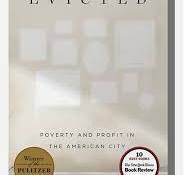
Evicted: Poverty and Profit in the American City by Jonathan Weiner is a comprehensive and enormously powerful study of the cycle of poverty in American cities brought about by the eviction of poor people from their homes.
Eviction is not just about eviction in the legal sense, where people get summoned to court for getting behind in their rent or violating their leases’ behavior standards, like engaging in domestic violence or drug use. He also includes those forced out of their homes by fires, substandard living conditions, health code violations, without due process, set adrift to find habitable and affordable housing elsewhere. Too many end up on the streets, sleeping in shelters. Eviction, in Weiner’s telling, deals with the gyre of how housing insecurity accelerates and perpetuates lives of poverty.
Weiner focuses on eight families in different housing arrangements, all of whom were in a downward spiral that only accelerated after eviction. From having a home, we get a sense of stability, a sense of belonging and self-worth, a sense of security. Rents for the poor may end up taking 80 percent or more of family income. Even if they succeed, they may end up with no heat or hot water, broken windows, non-working refrigerators, mice and cockroaches.
When they get behind in the rent and are thrown out, they end up in a constant search for a safe place for themselves and their kids. If they find something, it’s rinse and repeat. They’re hard put to buy clothes for school or put food on the table. Every move the family is forced to make means the kids may have to adjust to another school, sometimes as many as five or six in a single year. Often prospective landlords in the private market will refuse to rent to a family with kids, even if the law bars such discrimination.
When things get bad, the fathers of the children can end up in jail or just move out, leaving single mothers to foot the bills and solve the problems. The neighborhoods these women can afford get worse and worse and expose their children to drugs and violence. Waiting lists for housing are so long it can take years just to get on the lists, and some of the lists are closed. In their struggles, some poor people turn to alcohol and drugs themselves.
A history of evictions is itself disqualifying in public housing. Private housing landlords in the inner cities get essentially a free hand in determining who stays and who goes.
Weiner describes the cycle of despair in terms that are gritty, graphic, and authentic. He makes us smell the squalor, hear the chaos, taste the fear. Having grown up poor, he has a natural empathy. As a PhD student in sociology at the University of Wisconsin in Madison, he devoted himself to understanding the problems of players on all sides of the issue. For nearly two years from 2009-2011, he lived the life, first in a trailer park rental in the outskirts of Milwaukee, where he got to know the very real people he writes about. He was never without a notebook. His subjects knew full well he was writing about them and their challenges. They wanted their stories told. America’s housing crisis is real.
Most of the tenants in the trailer park were poor whites. He also moved on to live in the innermost parts of the city, mostly people of color. He spent hours in the housing courts learning the flaws of the process. He studied sheriffs, landlords, government bureaucrats, human services workers, addiction counselors and more. He details the shortcomings of the legal system. He developed statistical models to validate his findings from studying the lived experiences of his subjects.
Weiner concludes with recommendations, including especially a universal housing voucher program, not unlike the Section 8 housing vouchers that reach only about a quarter of those eligible. And not all landlords accept them. The waiting list can take at least two years. (In many places, the waiting lists are actually closed.) He maintains that, if fully funded, the nation can afford spending much more – just as the nation can afford the mortgage-interest deduction and other advantages it provides for homeowners.
He also urges that the government pay for legal services for poor tenants facing eviction. The landlords are typically lawyered up; tenants in civil cases are often unrepresented.
Every night of his study, Weiner would type up his notes, ending up with 5000 single-spaced pages. He maintained long-term relationships with some of his subjects, noting in the epilogue that a few of them had actually survived and stabilized their lives. His writing style is simple and direct, fact-driven and heartfelt. His 400-word book is human, moving, and eye-opening, well deserving of the Pulitzer Prize it won in 2017. It is as relevant today.
I welcome your feedback in the comments section. Click upper left to return to the home page then hit “Leave a Comment.” Book recommendations welcome. To be alerted when a new blog is posted, look for “Follow’ in the upper right portion of the home page, enter your email and click on subscribe. If you enjoy reading my blog, please share it with friends.
 Marjorie Arons-Barron