
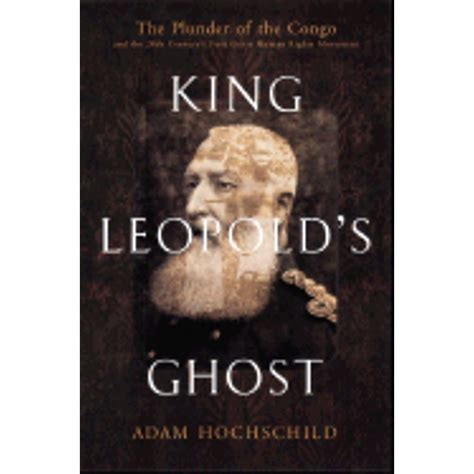
King Leopold’s Ghost by Adam Hochschild was first published in 1998, but its 2020 relaunch, with a forward by noted author Barbara Kingsolver and the author’s own afterword, attests to its relevance today. A dogged historical researcher, Hochschild documents the shameful capture of Africa’s Congo river and territory by the rapacious megalomaniac King Leopold II of Belgium, with particular focus on the 1885-1908 formation of his wholly owned Congo colony.
The subtitle of the book is A Story of Greed, Terror, and Heroism in Colonial Africa, the signature themes could as easily feature barbarism and brutality, courage and cruelty, power and profligacy. The effects of Leopold’s ruthlessness are still manifest today in the continuing problems of much of post-colonial Africa. And sadly, throughout history, the atrocities were not unique to Belgium. A century ago, the Congo was raped for its diamonds, gold, ivory and rubber. Today, it and other African countries are exploited for the rare minerals necessary for computer chips and other modern technologies.
King Leopold’s Ghost displays Hochschild’s brilliance as a non-fiction writer, driving the narrative by bringing alive historical figures, many of which we may have only known by headlines. (It was a technique I greatly appreciated in his noteworthy books American Midnight and Spain in our Hearts.)
His writing tends toward the cinematic. While King Leopold starts with a centuries-old history of slavery, Hochschild captures the imagination with American journalist-turned explorer Henry Morgan Stanley. Adopted as an orphan, Stanley went on to became an international celebrity for finding missing Congregationalist missionary/explorer David Livingstone, who had disappeared for five years in the uncharted territory of the Congo. Stanley’s often-wildly-exaggerated newspaper articles and lectures about his travels up the Congo River caught the attention of King Leopold, keen to use Stanley to further his goal of acquiring a colony in Africa. Stanley confiscated land for Leopold, in the process abusing his porters and torturing them to secure their work output.
Former American emissary to Belgium Henry Shelton Sanford worked for the King, lobbying in Washington for U.S. recognition of the King’s claim to the new Congo region, support driven by Southerners’ post-Civil War hope that newly freed American slaves could be persuaded to return to Africa.
To feed his greed and raise more money for his misnamed Congo Free State, Leopold franchised corporations to exploit tribal properties, taking half their profits to expand his dominion. In the name of bringing civilization to savages, he turned a blind eye to the kidnappings, torture, starvation and disease that befell the exploited natives forced into labor. Many of the perpetrators became the models for characters in author Joseph Conrad’s Heart of Darkness. Mark Twain’s King Leopold’s Soliloquy used satire to oppose Leopold’s atrocities.
There were good guys too, including George Washington Williams, a black American Harvard graduate and newspaper man who became pastor of Boston’s 12th Baptist Church and later was a member of Congress from Ohio. He decried the “crimes against humanity” in an open letter to King Leopold, incurring his royal wrath but helping to fuel the nascent reform movement.
Also figuring prominently was Edmund Morel, a clerk for a British shipping company, who noticed that what was being taken out of the Congo far exceeded the value was going back in. His sustained efforts to publicize the truth about Leopold’s criminal endeavors became an international human rights movement (the Congo Reform Association) to fight the exploitation. A contemporary of Morel was Roger Casement, who worked for the British diplomatic service, also bravely exposed atrocities in the Congo and went on to fight for Irish independence.
Beyond Leopold’s empire building, he was noteworthy for his multiple dalliances with very young women (his longtime favorite a 15-year-old call girl). He had no interest in literature or music. His energies focused on constructing of lavish chateaux, elaborately decorated pavilions, promenades and parks, most embellished as monuments to him. He loathed the journalists who investigated his crimes but was a master at manipulating compliant press.
Hochschild has been criticized for not naming native African sources for his revelations. But even access to general reports of investigations of slave labor were kept archived in Belgium until the late 1980’s, when people were finally allowed to read them. Critics have also questioned his estimate of eight to ten million deaths from forced labor in the Congo.
Again, the problem is one of record-keeping – or lack thereof – and what one infers from diminished numbers of already sketchy census totals. Some official sources still gloss over the scope of the atrocities, and Belgian’s Royal Museum for Central Africa is silent.
Belgium is unique neither in its slave trade nor the reluctance to admit to the extent of the barbarism. The value of this book, even a quarter of a century after its initial publication, is its resonance with today’s authoritarians, corporate plunder and enduring racism. It is a well executed historical narrative that stands out for the quality of its writing and its capacity to illuminate the heights and depths of human beings.
I welcome your feedback in the comments section. Click upper left to return to the home page then hit “Leave a Comment.” Book recommendations welcome. To be alerted when a new blog is posted, look for “Follow’ in the upper right portion of the home page, enter your email and click on subscribe. If you enjoy reading my blog, please share it with friends.
 Marjorie Arons-Barron
Your readers may be interested in another critique of the atrocities which took place in the Congo, written by Arthur Conan Doyle (the author of the Sherlock Holmes stories) almost a century earlier than Hochschild’s book. THE CRIME OF THE CONGO was published in 1909 in London (Hutchinson and Company) and in New York by Doubleday, Page and Company. Doyle wrote a special preface for the American edition, which begins “There are many of us in England who consider the crime which has been wrought in the Congo lands by King Leopold of Belgium and his followers to be the greatest which has ever been known in human annals.”
LikeLike
Hochschild does include Conan Doyle’s activism in this book.
LikeLike
Margie – Good book review. I
LikeLike