
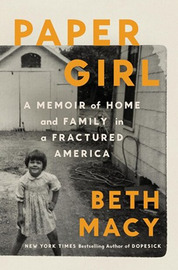
Paper Girl: a Memoir of Home and Family in a Fractured America by journalist Beth Macy is a perfect complement to my just-reviewed Buckeye by Patrick Ryan. Think of Paper Girl as small-town Ohio, part 2, the contemporary, non-fiction version.
Macy grew up in Urbana, Ohio, graduating from high school in 1982. Though four generations of her family suffered from addiction, abuse, teen pregnancy and poverty-related struggles. Beth herself had been an unruly teenager, yet she still responsibly delivered newspapers on her bike, played in the high school marching band, finished high school, graduated from college and got a job writing for the Urbana Daily News, the same paper she had delivered to her neighborhood as a youngster.
Eventually, she moved elsewhere for jobs with bigger papers, returning home only rarely to visit her mother. Over several decades, she came to discover that “something was rotting beneath the surface” of her “postcard-cute” hometown. She decided to return regularly to Urbana for two years to dig deeper and deeper into the shocking changes she observed. What she discovered became this powerful fact-based memoir that helps the reader understand more viscerally the huge divide that poisons America today.
Urbana could well be what Ryan’s fictional town of Bonhomie would become today. Interestingly, Urbana is just a little over an hour’s drive from J.D. Vance’s birthplace in Middletown, Ohio. Macy responded one way by documenting systemic failures. Vance (and Trump) respond to the same issues by opportunistically blaming liberals, immigrants, minorities and the deep state for the despair experienced by frustrated whites.
Under the pressure of globalization and the offshoring of jobs, the decline of unions, inroads of technology into job availability, Urbana’s middle class had been hollowed out. There were huge wealth gaps between the few remaining factory owners and bankers and the growing tranche of poor, who had become mired in hopelessness and resentment.
Public schools are failing. Third graders are failing miserably at reading and math. Absenteeism is endemic. Parents distrustful of public schools’ wokism are homeschooling their kids, supplementing that often-flawed education with rigid Bible-based “character-building” courses. Classic books have been banned. College has become out of reach due to disinvestment by federal and state governments in both liberal arts and vocational education. Those few who managed to start higher ed have typically not finished but are still saddled by student debt. The American Dream of home ownership is a mirage.
Worse, since substantive local journalism (once “society’s glue”) went away, overshadowed by misinformation on the internet and social media, conspiracy theories have become widely regarded as truth. (Springfield, Ohio, home of Trump’s fabricated Haitian dog-eating story, is less than 14 miles away.) Internet outrage, Macy writes, has become the reigning religion of America. Macy’s own sister (Cookie) and Beth became estranged. Cookie, stuck in a toxically abusive marriage, became increasingly imbued with Christian nationalism fueled in her own church, and comfortable with white supremacist rants. For reporter Macy, the despair and alienation are, in her own family, the lived experience.
Disclosures from the Epstein files about the sordid behavior of degenerate wealthy elites at wild parties with underage girls sadly gives oxygen to Qanon conspiracy beliefs widely held in Urbana. Qanon obsessions are just a small slice of Macy’s memoir, which my friend Paul, who recommended the book, says should be required reading for any Democrat, or anyone else concerned about our toxic polarization.
Macy is short on prescriptions, except for urging readers trying to bridge he divide to find common ground on neutral topics (Sports? Recipes? Grandkids?) and build relationships from there. But she concedes that such approaches, while effective, are not easily scalable. (See my review of How Minds Change, by David McRaney.)
Though her memoir is rich with data, Macy weaves her own personal difficulties in and out of what could have become just another sociological tract. In the process, she humanizes the huge challenges we face as a nation.
In the wake of Donald Trump’s clearcut win in 2024, Paper Girl could serve as a primer for those getting out of their bubbles and going into the ’26 mid-terms and the ’28 Presidential race beyond.
I welcome your feedback in the comments section. Click upper left to return to the home page then hit “Leave a Comment.” Book recommendations welcome. To be alerted when a new blog is posted, look for “Follow’ in the upper right portion of the home page, enter your email and click on subscribe. If you enjoy reading my blog, please share it with friends.
 Marjorie Arons-Barron