
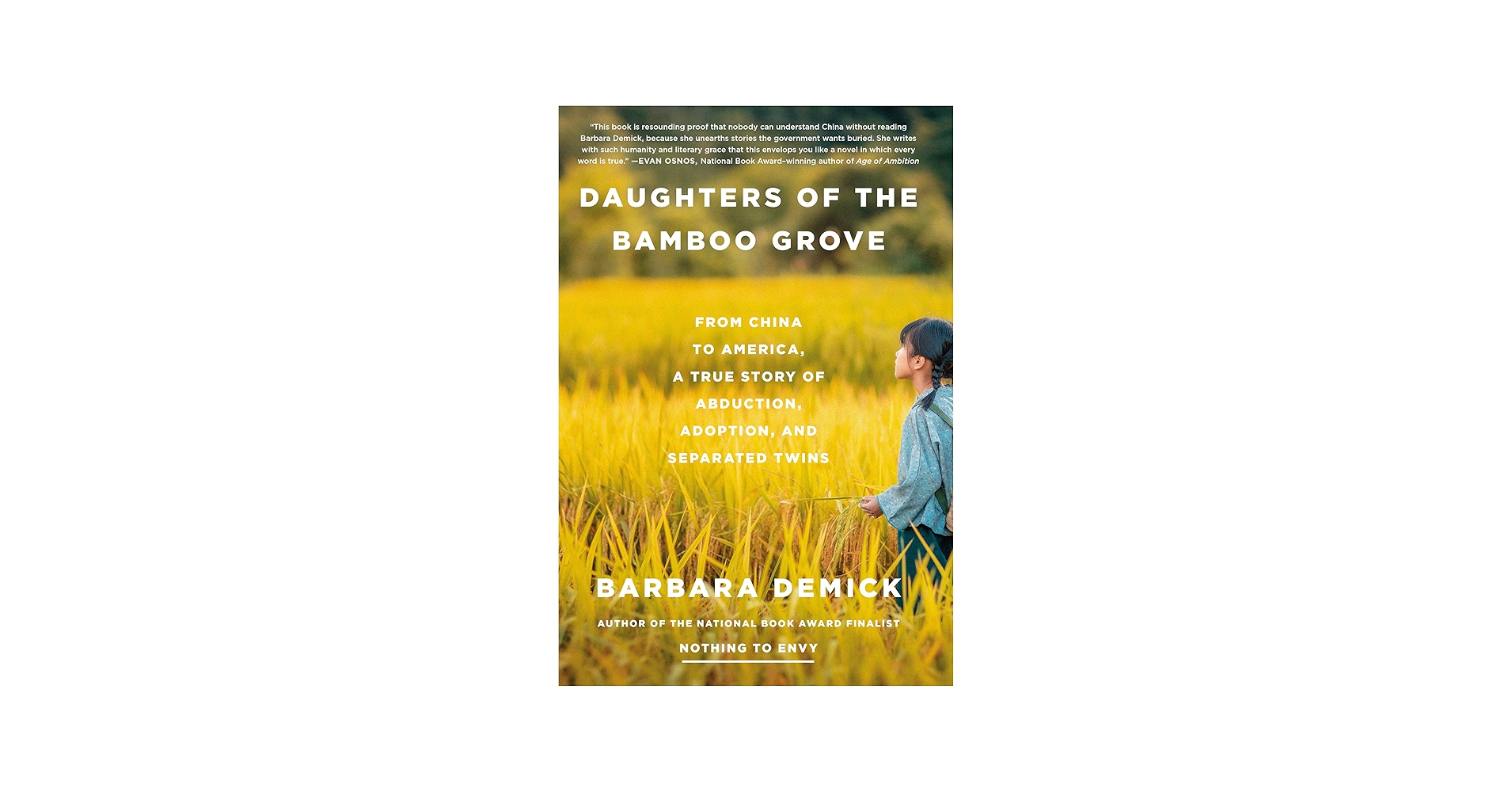
Daughters of the Bamboo Grove: From China to America by Barbara Demick is a stellar piece of journalistic reporting in book form, laying bare in well-researched details the far-reaching impacts of China’s One Child Policy. For more than 30 years, Chinese women who became pregnant were subjected to forced abortions, mandated sterilization, and fierce beatings. Unwanted babies, especially girls, were often killed and buried.
Assigned to the Los Angeles Times Beijing Bureau, Demick chronicles the complications if the parents were determined to keep their “illegal” children. She follows the gut-wrenching separation of identical twin girls in a rural village of China, to be raised secretly by family members so mother (Zanhua) and father (Youdong) could leave their village to earn more money to support the family. Because their births violated the legal limit, the government imposed huge fines on the couple, another force driving the parents to seek work far from their village.
In that situation, it was typical for Chinese Planning Officials to strip parents of their home and belongings and to seize the babies from families. In this case, Demick reveals how one twin, baby Shuangjie, was abducted by those officials, who declared her simply to have been abandoned.
Typically, government agents would hustle the kidnapped babies off to a Social Welfare Institute orphanage, refusing to provide distraught parents any information about the babies’ whereabouts. Anguished parents would search for their children to no avail. Some of the parents committed suicide. Many of these stolen children would later be trafficked for forced labor or to be sexual partners, domestic servants or brides. As Demick records, the U.S. State Department estimated in 2015 that some 20,000 children in China were kidnapped every year.
In the 1990’s, when international adoptions became more desirable, the Chinese government figured a way out of the costs of maintaining these children as wards of the state. Working with favored adoption agencies, officials would charge substantial fees for arranging adoptions, effectively selling babies to families, often American, who were provided false documents filled with lies about the children’s “abandonments.” By the early 2000s, China was the largest source of children adopted internationally, 95 percent of whom were female. The fee-supported revenue stream for the Chinese government incentivized more kidnapping.
This book, published in 2025, was built on the foundation of articles Demick wrote in 2009 about stolen babies filling international adoption demand. According to her, adoptive parents thought they were saving these children from institutionalization or death, but they were, she asserts, “becoming end consumers in a repressive system that might have fueled kidnappings.”
Demick follows Zanhua’s and Youdong’s search to find their Shuangjie, using the investigative skills of her profession and network of contacts. It took years, but eventually she found the adopted twin in a modest home in Texas. Working with all the parties involved, she arranged a reunion in China. By now, the separated Shuangjie and Fang were in their early teens.
The story doesn’t end there however. Demick explores how separated Chinese children sometimes feel at home in neither culture. Those who legitimately had been abandoned, rather than abducted, have their own particular burden of stigma to carry. The adoptees often feel they are being unduly scrutinized, which is especially true of separated twins, frequently studied for scientific research on the eternal nature-versus-nurture question.
Ironically, the One Child Policy has helped create a population shortfall for China today. Fewer girl babies surviving a generation ago means fewer women of child-bearing age today. Today’s headlines proclaimed China’s birth rate – the lowest since 1949 – a demographic crisis. There are implications for the Chinese economy yet to be felt over the next decades.
Demick’s coverage of China’s great historic convulsions (from Mao’s Great Leap Forward, to the Cultural Revolution, the One Child Policy to the anti-democracy crackdown in 1989, thorough as it is, doesn’t minimize in any way the human impact on those affected. The anguish of the families is no less than the struggles of some adoptees to adapt to their new homes and countries while, as the author puts it, they are “tethered by blood to another family and country they struggle to comprehend.”
As a (former) journalist, I was particularly interested in how Demick dealt with the reporter’s dilemma of stepping beyond the mere reporting of a story to becoming a player, involving oneself in the evolving outcome for the benefit of the people whose stories so moved her. We saw this in New York Times columnist Nick Kristof’s memoir “Chasing Hope,” reviewed in October. In both cases, the writer’s decision to engage personally says much about the humanity of the person telling the story, amplifying the importance of the story being professionally researched and revealed. This dimension greatly enriches readers’ understanding and compassion.
I welcome your feedback in the comments section. Click upper left to return to the home page then hit “Leave a Comment.” Book recommendations welcome. To be alerted when a new blog is posted, look for “Follow’ in the upper right portion of the home page, enter your email and click on subscribe. If you enjoy reading my blog, please share it with friends.
 Marjorie Arons-Barron